
MEMORIES FROM PETER QUINCEY
Peter’s ancestors are recorded in the Lilford Parish Registers as far back as 1560. Over the following five hundred years, the family name appears in many of the villages around Oundle.
Peter’s great-grandfather came from Barnwell, but the surname Quincey was not known in Woodnewton until 1914. At that time it appeared on Woodnewton’s electoral roll as a property owner, although the residence listed was in Apethorpe.
Peter’s grandfather, James Edward Quincey, was living in Yarwell until 1899, where he worked as the village blacksmith. It was there that Peter’s father, Frederick Quincey, was born in 1896.
By 1901, James and his family had moved to Apethorpe, where he took over the wheelwright and blacksmith business on the High Street. This was a much larger property, allowing him to house his family of nine children, two of whom were stepchildren.
n 1910, when Frederick was fourteen years old, he left school and entered the blacksmith trade, working for his father. As two of his brothers were also working at home, this may have prompted James to rent the blacksmith’s shop in Woodnewton as well.
When Frederick married Louisa Flack in 1927, he took his bride to a semi-detached cottage at 21 Main Street, Woodnewton, which was later named Bryony Cottage. It stood opposite the Blacksmith’s shop.
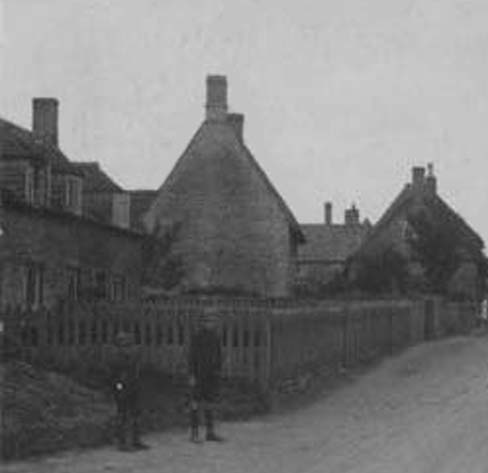
Peter had an uncle and aunt, William and Dorothy Roberts, who went to live at Sunnyview with his grandfather after his grandmother died. William died in 1956. Dorothy died later, in 1971, after suffocating from smoke inhalation caused by a smouldering electric blanket. The cottage was then sold for £10,000.
Peter was only ten years old when the Second World War began. He remembered collecting spent ammunition from around the area with his friends so they could try to make their own bullets. He also recalled that two searchlights covered Woodnewton during the war: one at the top of the hill between Nassington and Woodnewton, and another on Hind’s Field, known as the playing field, near the white cricket strip.
Four army tents were set up behind the Blacksmith’s shop on this field, where soldiers were stationed during the war. Their sergeant was Mr Chambers from Cherryholt.
Peter also remembered a lodger, George Martin Parnum, who lived with his aunt and uncle. George drove a fruit and vegetable van for Mr and Mrs Walker of Franey House.
Next door at 21 Main Street lived George Reginald and Margery Elizabeth Compton. George worked for the Forestry Commission. In Hazel View, a converted barn at the rear of the house, lived Mr and Mrs Ernest Freshwater. He worked as a dispatch clerk for a miller’s merchant.
Mr and Mrs George Spademan kept a milking herd and were among the farmers who supplied the village with milk. They lived in the farmhouse on the edge of Strickson’s Yard. The other two families who lived at the bottom of the yard were Ronald and Rose Knight, and John and Lizzie Briggs. Ronald Knight was Peter’s step-uncle. Lizzie Briggs had once been a lady’s maid at Rockingham Castle and always had a story to tell.
To the west of Peter’s house stood another thatched cottage called The Gardens, where Macdonald and Vera Allen lived with their family. Jean Allen, their second daughter, started school shortly after Peter.
Peter was the only child to begin at Woodnewton Primary School in the summer term of 1934. The head teacher was Mrs Daisy Davies, and Miss Ethel Black taught the infants. Miss Black had a rocking horse in the classroom, although Peter never remembered having a ride on it.
He left the village school on 3 August 1940 after gaining a scholarship to Oundle School. To mark this achievement, he was given a bicycle by Mr Brassey of Apethorpe.
Five years later he won a place at Cambridge, but unfortunately he was unable to take it up because of the family’s financial situation. Instead, he joined the Navy at the age of seventeen and left the village to serve on the submarine Alliance. During his time on Alliance he completed a radar course and later spent a year in Malta teaching other submariners under the leadership of Philip Mountbatten.
Peter remembered that life at Bryony Cottage was very simple. Water came from a well at the bottom of the garden, the toilet was outside, and there was no electricity in the house. He also recalled hearing rats running about in the eaves while he lay in bed. As a child he loved reading, and the Rupert Bear strip books were among his favourites.
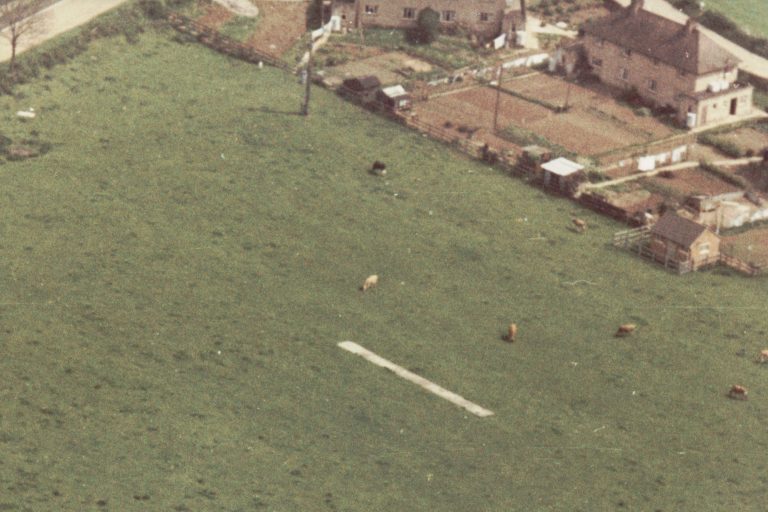
I was only 10 years old when World War II started and I remember collecting the spent ammunition from around the area with my friends so we could make our own bullets. I recall that there were two searchlights which covered Woodnewton; one at the top of the hill between Nassington and Woodnewton and a second one on Hind’s Field, known as the playing field, near the white cricket strip. There were four army tents situated behind the Blacksmith Shop on this field where the soldiers lived during the war. Their sergeant was Mr Chambers from Cherryholt.
Towards the end of the war, Peter remembered seeing Crago’s plane fly low over the school. Together with his friends, he was among the first to reach the scene after it crashed, and they found the pilot’s helmet.
He also remembered singing in the church choir and carrying the incense during services. As he grew older, his main interest became cricket, and he played for the village junior cricket team. He recalled helping to paint the white cricket strip on Hind’s Field. Access to Hind’s Field from Main Street was by a stile in the wall between Sunnyview and the neighbouring cottage.
The Quincey family left Woodnewton for Nassington in 1950.
Peter recalled his memories to me in December 2018.