JOYOUS-OPENING OF THE RESTORED EDIFICE
THE BISHOP’S EXCELLENT ADVICE
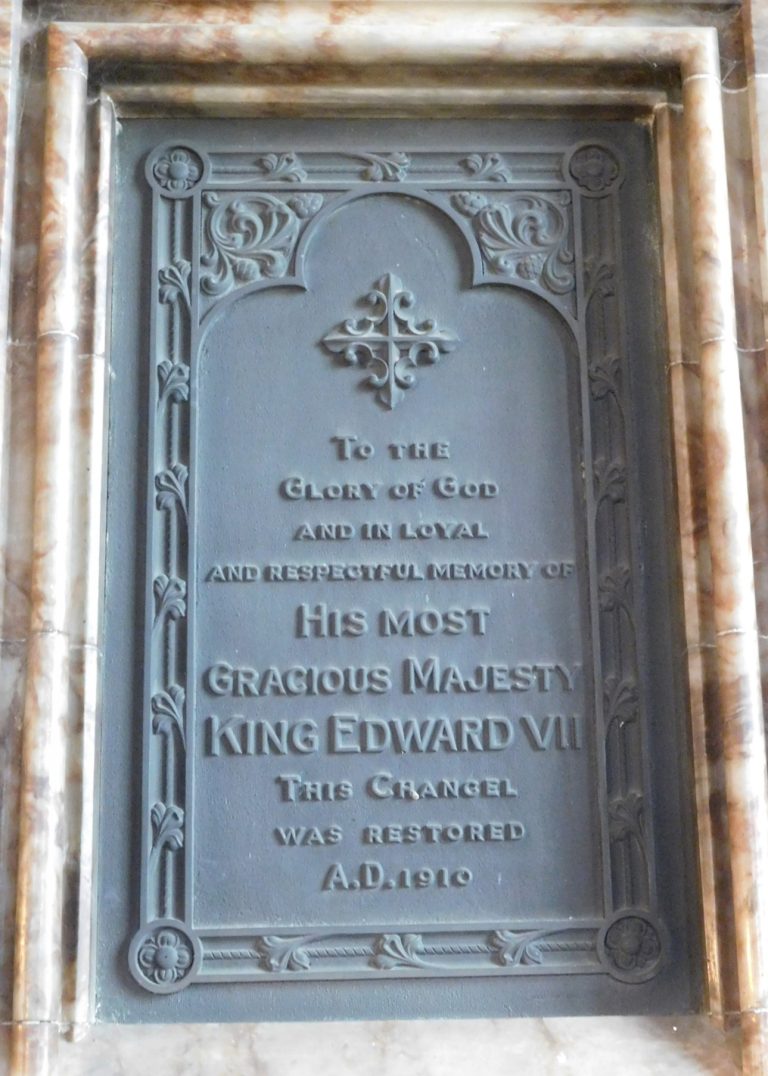
Although at the unusual hour of 5.30 on Saturday evening, the duet of the Woodnewton bell-tower’s occupants was heard for miles around, no one asked why, for the whole district knew of the magnificent restoration of the church of our Lady, and that the Bishop of Peterborough was coming for the formal opening of the completely restored edifice. It is a very ill-wind that allows no one good, and the lamentable death of the late King Edward has resulted in the perfect re-construction of the chancel of the Ancient Church. “In loyal and respectful memory of His Most Excellent Majesty, King Edward VII, this chancel was restored by Henry Leonard Campbell Brassey, 1910” to quote from the plate on the north wall of the chancel.
The generous Patron (Mr Leonard Brassey, MP) had previously decided to restore the body of the Church (which was in a lamentable state of decay) to the unbounded and grateful delight of the deservedly-popular Vicar of Woodnewton-cum-Apethorpe and his parishioners. Never, however, did the most hopeful believe that the restoration would bring about such a miraculous change as was evident on Saturday night. Gone are the creaking planks of the floor, the worm-eaten and uncomfortable straight-back pews, the plastered walls, the smoky ill-lighting lamps, the tin-kettle bells and the general impression of “don’t-care-about-the-place”. In place of these are found a noiseless wood-block floor, rush-seated chairs with “pockets” for books, and handsome crimson kneelers attached, the neat bareness o the stone walls, attractively “pointed” the brilliant light of the lamps and, may be best of all, a wonderful revival of the life religious of rational zeal that has become infectious since the advent of the new Vicar.
To return to Saturday night, the beautiful church had not one empty chair, and the hoard-headed were moist-eyed as they thought and said they “should hardly have known the place” while the younger generation were delighted to know that their Church was so improved that the worshippers could no longer be taunted with “What a miserable old Church you go to!”……..The Rev A G Bagshaw, MA (Vicar), accompanied by his brother, the Rev H F Bagshaw, MA (Vicar of Chatteris), the Rev D A Jones (Nassington), the Rev J W Jones (Yarwell), the Ref F Hawkes-Mason (Tansor), together with the Bishop and the surpliced choristers marched joyful and reverently to the chancel during the singing of the processional hymn, “All people that on earth do dwell”. In close attendance on the Bishop and Clergy were the Churchwardens (Mr C Wade and Mr Thos Wells) and Sidemen (Messrs H Wade, G Bosworth and J Barfield). Owing to illness, only half the number of boy choristers were present, and this prevented the singing of the special anthem, but the congregation enjoyed none the less the truly congregational hymns, Psalms and Canticles in which they heartily joined Mr B Brice proved an able Organist and the musical part of the service was excellent, as was expected by all who know the abilities and determination of the musical Vicar, and his colleagues, the organist and choristers. The service was intoned by the Vicar, who also read the special lessons, and after the hymns, “Jesus wher’er Thy people meet” had followed the third collect, the Bishop approached the Communion Table and there formally offered, in suitable prayers the “restored old Church to Almighty God”, praying that the Building set apart of old for the worship of God, and now renewed, might be the scene of worship in truth and purity”. The hymn, “Praise the Lord, ye Heavens adore Him”, was splendidly sung.
His Lordship then ascended the pulpit and preached a thrilling sermon from the text, “For my brethren and companions’ sakes, I will wish thee prosperity. Yea, because of the House of the Lord Our God. I will seek to do thee good”. After alluding in grateful terms to the munificence of the Patron, who had so perfectly restored the Church, and to the other gifts that “pious hearts had made” the Preacher said that the beautified house quickened our pulses as regarded our spiritual relationship, the one to the other. The religion we followed should make us comrades, fellows and companions in Jesus Christ. “If there be any here who have any ill-feelings or resentment of any kind towards a neighbour, make haste to get rid of such feelings so that there may be perfect unity”. Speaking with considerable emotion, the Bishop went on, “Let us remember that this Holy House should be the image of our souls, cleansed, renewed, beautified as this building has been”. “Will the regular worshippers remember that this house is for all, and do all they can to bring into the fold those now outside. The blessings you enjoy are also for those, at present, non-worshippers. In the highest sense of the word, do those souls good by influencing them to come regularly to this house of God, and to renounce their evil lives. May you all be drawn towards a more faithful service in God’s house, a more reverent, and a more frequent. Time is short, opportunities are many and great”.
During the collection for the bell fund, “The Church’s one Foundation” was the reverent out-pouring of thankful hearts. Then followed the Benediction by the Bishop, and then, as a recession. “Now than we all, Our God”, was sung by all while the long and imposing procession wended its way to the vestry.
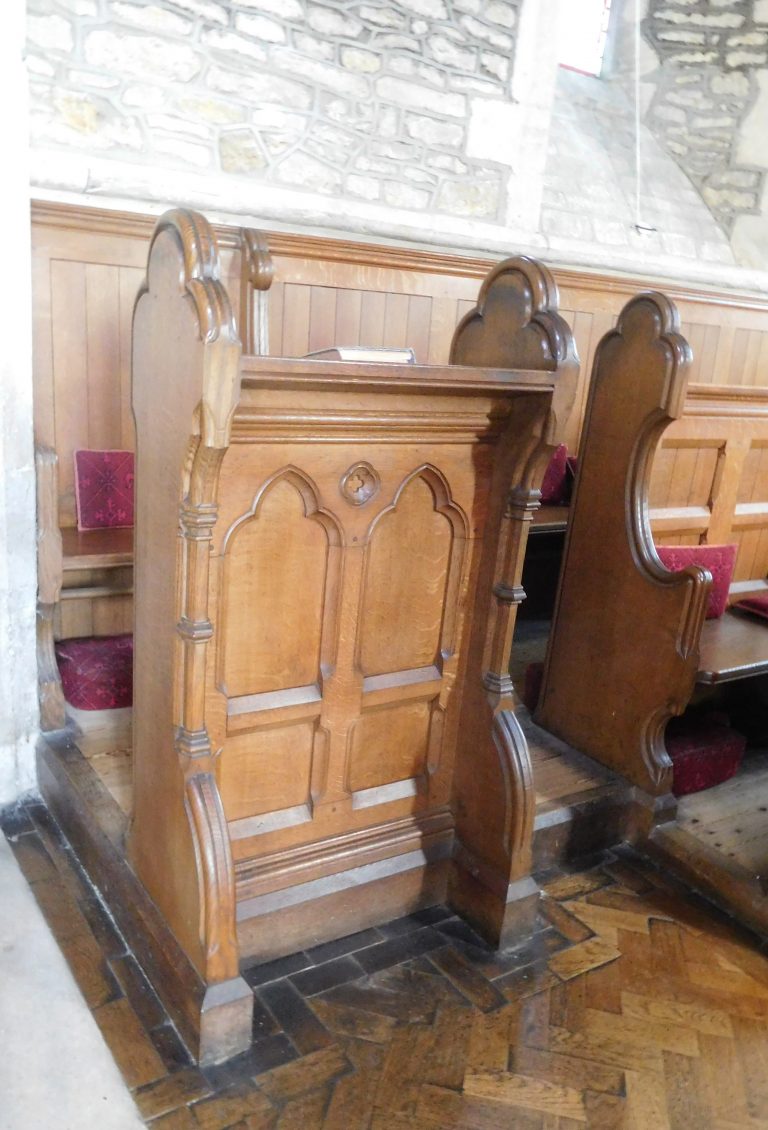
And so, the service ended, but the worshippers were loth to leave the building, many staying to view the Church now so unlike its former self. On all sides were heard devout murmurs of gratitude to the liberal Squire, whose practical religion had shown itself in no uncertain manner. The chancel, with its beautifully carved altar with blue figured plush curtains, the quaint prayer desks, the carved oak choir stalls, all proved objects of thankful attention. Among the other gifts “pious hearts had been moved to give” were a Bible for the lectern (Mrs Johnson and family); altar service book, Mr and Mrs Bosworth; Prayer Book for reading desk, Mrs Bagshaw; carved oak Litany desk, Mr W Bassett-Smith (the Architect); Hymn board, Mr H Wright. Among the large congregation we noticed the Patron of the Living, Mr Brassey, MP, Capt Harold Brassey, Miss Glyn, Mrs Bagshaw, the Rev F Buttanshaw, the Rev G Houndsfield, Mr Gordon Wilson, Mr W Bassett-Smith etc. It was known with profound regret that Lady Violet Brassey was unable to be present on account of ill-health.

 Brassey commissioned Maurice White of Cromwell Road, Peterborough, to carve the label terminals with heads of King John and Bishop Chichele. The Chancel had a new oak roof fitted and oak choir and clergy stalls. Oak panelling was inserted around the walls to the base of the windows. The flooring was laid with oak blocks.