
This is a revised account of a report that first appeared in the December 2018 edition of “Woodnewton News” to mark the 75th anniversary of the accident that caused the death of John Walter Crago . The report was subsequently uploaded onto the Woodnewton History Group website in early 2019. This revision incorporates additional information received from the Cambridge American Cemetery and Memorial, via the Kings Cliffe Heritage Group, to which the History Group extends thanks.
On the morning of 31st December 1943 a United States Army Air Force plane crashed in the field known as Stepping End, just beyond Conegar Farm, Woodnewton. It was being flown from RAF Wittering to the USAAF airbase at Kings Cliffe by 2nd Lieutenant John Walter Crago. He died in the crash.
Lieutenant Crago was born on 5th April 1917 in Philipsburgh, Pennsylvania, the son of Walter P Crago and Margaret K Jones. Whilst his parents were citizens of the USA it is known that his grandparents emigrated from England in the 1880s. They had originally lived in Cornwall, where his grandfather was as a miner, then moved to the coal mining area of County Durham, before emigrating to the USA. Unsurprisingly, Philipsburgh is in the coal mining area of Pennsylvania.
Lieutenant Crago enlisted in March 1942, for the duration plus 6 months, and was a member of the 55th Fighter Squadron of the 20th Fighter Group. This Group was under the command of the 67th Fighter Wing of the Vlll Fighter Command of the USAAF. When he died he was 26 years old.
This account of the accident on 31st December is based on USAAF records, on records from those serving at Kings Cliffe at the time, and two accounts held by the History Group told by former residents of Woodnewton (although these may not be contemporary with the event).
The USAAF was assigned RAF Kings Cliffe in early 1943 and it was re-designated as Station 367. It was the most northerly and westerly of all US Army Air Force fighter stations. At that time RAF Kings Cliffe lacked sufficient accommodation and other basic facilities, so the Americans undertook an extensive building programme at the base. The 20th Fighter Group arrived on 26th August 1943 from its training base in California having crossed the USA by railway and then the Atlantic aboard the Queen Elizabeth on a five-day unescorted trip. The Group comprised three Fighter Squadrons; two of those Squadrons were based at Station 367 whilst the third, the 55th Fighter Squadron (Lieutenant Crago’s), was based at RAF Wittering whilst the additional accommodation was being built at Kings Cliffe. The Group did not come back together at Station 367 until April 1944.
Until December 1943 the Group had flown Republic P-47 Thunderbolt planes. With the arrival of their new Lockheed P-38 Lightenings in late December 1943 the 20th Fighter Group was able to enter fully into operational combat by providing escort and fighter support to heavy and medium bombers to targets in occupied Europe.
On the morning of 31st December 1943 Lieutenant Crago was to fly from RAF Wittering to Station 367 to be briefed on his first combat mission – to provide escort protection on a bombing mission to attack an aircraft assembly factory at Bordeaux and an airfield at La Rochelle. (This was a part of only the 3rd mission by the fully-operational 20th Fighter Group flying P-38’s.) The reports of the residents of Woodnewton say that the planes of the 55th Squadron took off from RAF Wittering three abreast but unfortunately the right wingtip of Lieutenant Crago’s plane struck the top of a search light tower on take-off. However, an early official record of the USAAF reports “Fatal take-off accident in training flight on 31-12-43. Killed in training accident (KITA).”

Subsequently, the USAAF recognised that Lieutenant Crago was flying to Kings Cliff to be briefed on a mission. The record was amended to read ”Fatal take-off accident 5 miles east Kings Cliffe. Cat 5 damage, 31-12-43. Killed in action (KIA)”. He was awarded the Purple Heart.
Notwithstanding this record, reports from the airbase at Kings Cliffe state that Lieutenant Crago had radioed stating that he could not retract his landing gear. He was instructed to fly low over the control tower and the controllers saw smoke coming from his left engine. This would suggest that the pilot had control of the plane to be able to carry out that manoeuvre. Nevertheless, a short time later his plane crashed.
Two accounts from residents of the village report that the plane approached from the north-east, flying very low over Back Lane (Orchard Lane) and St Mary’s Church before crashing in the field known as Stepping End just beyond Conegar Farm. Those reports say that the pilot discharged his guns to warn people on the ground that he had lost control of the plane and was about to crash. Both accounts record that the (right) wingtip of the plane had struck a search light tower at take-off. Wreckage from the plane was still visible in Stepping End in the 1950’s and a “drop tank” (for additional fuel) could also be seen in the hedge between Kings Ground and Checkers.
Stepping End is the first open field – no hedges or fencing – on the right-hand side of the track from Woodnewton to Southwick. From Mill Lane, cross the bridge over the Willowbrook, and continue until the land begins to rise at the start of the hill. Kings Ground and Checkers are the next two fields on the right along the same track.
It is understood that 2nd Lieutenant Crago, whilst no doubt a qualified and proficient pilot, had had only 7 hours flying experience in the Group’s new P-38 Lightening at the time of the accident. The P-38 was a notoriously difficult plane to fly and had many problems but was brought into service quickly before those problems were fully resolved. It was known that if a plane was damaged at take-off, and this resulted in the loss of an engine, the P-38 produced an uncontrollable yawing and the aircraft would flip-over and hit the ground.
From the information available, the History Group can only speculate about what actually happened to Lieutenant Crago’s plane between the base at Kings Cliffe and the crash site at Woodnewton. Woodnewton would have been on the flying circuit back to the base so he may have been trying to get back to Kings Cliffe to land. If this was not possible the large open field of Steeping End may have been seen as a site for an emergency landing that went tragically wrong. On the other hand, Lieutenant Crago’s P-38 may have lost the power from the engine damaged at take-off, and this caused the plane to yaw and crash. Given that he was flying low at the time, this catastrophic loss of power must have happened over Woodnewton, seconds before the crash. Another possibility is that the engine may not have failed but was closed down to try and extinguish the fire, but obviously switching off the engine would result in a loss of power and yawing.
Other matters also remain unresolved, not least of which is that there is no official explanation of the accident at take-off from RAF Wittering. Why or how, and indeed which of the plane’s engines or wings was damaged cannot be confirmed.
A memorial plaque to Lieutenant Crago was put up in St Mary’s Church to commemorate his death. The wording on this memorial faded over time however, and the plaque was replaced in 2001, although the wording on the two plaques is the same.
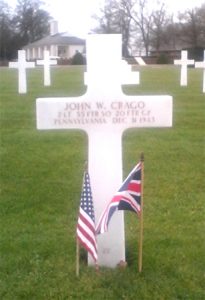
2nd Lieutenant John Walter Crago is buried and commemorated at the Cambridge American Cemetery and Memorial (Plot A Row 5 Grave 22).

2020