
Company Sergeant Major Percy COMPTON
Bedfordshire Regiment 9931
The Compton family first appeared in Woodnewton, when James Compton from Nassington married Mary Elizabeth Hull in 1882. The Hull family had been living in Woodnewton since the middle of the 1700’s and descendants are still living in the village today. The couple lived in a cottage at the east end of the village, possibly tied to the Willowbrook Farm as James was listed as a Labourer during the 1881 census.
Mary went on to give birth to 13 children of which two died at birth. James William, her first child, born 1885, Richard, born 1887 and Percy, her fourth son, born on 12th March 1893, went on to serve in the First World War.
By the 1911 census, the Compton family, consisting of mother, father and 9 children, are shown living in the area of Church Row, which is on the north side of the church. The move to a smaller cottage must have been provoked by James moving jobs to a farm on Apethorpe Estate as these cottages at Church Row belonged to Apethorpe Estate. Percy is described as being a farm labourer too; the same occupation as his father and older brothers, so they could all have been working together.
The third brother, Percy, and the most recognised of the three brothers enlisted at Peterborough in the 2nd Battalion of the Bedfordshire Regiment. He landed in Zeebrugge on 6 October 1914 and the division moved almost 40 miles south to meet the rest of the army and on 18 October 1914, around the 10km marker stone on the Ypres-Menin road, they met the German Army for the first time in a brief skirmish.
The following day saw the division attack Menin and the battalion were joined in a European battle for the first time and was engaged in the First Battle of Ypres until 23rd November 1914. Percy was awarded the Mons Star and Clasp for his part in this battle. He also received the Victory Medal too for his role within the Battallion. He was also promoted from Lance Corporal to Company Sergeant Major.
The 2nd battalion spent the period until early March 1915, in the trenches around Fleurbaix before moving into reserve to train in readiness for the coming operations around Neuve Chapelle. The offence started on the 10th March and by the 13th March, 15 soldiers from Percy’s Division had been killed, 66 wounded and 5 missing.
Although, Percy’s regiment served in the second battle of Ypres, battle of Loos, battle of the Somme and Arras, over the next two and a half years, the next time we read of Percy’s heroism is in an entry on 20th September 1917, when he was part of a raiding party at YPRES – COMINES CANAL, made up of 50 other ranks, who had orders to raid the Centre of Movement for the purpose of collecting information, capturing Prisoners, Machine Guns and damaging Dug-outs. Several of their soldiers were wounded
At the beginning of October, an entry in the Batallion’s diaries says that they were in trenches near Hollebeke and the following morning the battalion were in line when Serg Percy Compton was awarded the Distinguished Conduct Medal from his Commanding Officer, Capt Holbrook.
Later in October when the battalion was at the Chinese Wall Line at the Battle of Messines Ridge, a presentation of Medal Ribans were made by by Lieut. General Sir Aylmer Hunter Weston KCB. DSO, to three soldiers one of which was Percy for his DCM award.
The citation for his Distinguished Conduct Medal was published on 5th February 1918 in the London Gazette, Issue 30512, and read: 9931 Sjt. P. Compton, Bedf. R. (Wansford, nr. Oundle).
“For conspicuous gallantry and devotion to duty with a raiding party ordered to raid the enemy’s concrete posts. On reaching the objective they were held up by wire and came under severe fire from two machine guns and snipers, at about 20 yards range. He tried to put a machine gun out of action by firing rifle grenades at a slit in the concrete post. When ordered to withdraw he brought back wounded and put them in shell holes. He again returned to the enemy’s wire and helped more wounded in to cover, and then crossed No Man’s Land under heavy fire in broad daylight to get stretchers.”
Coinciding with this citation appearing in the London Gazette, back at the front Percy was being awarded the Belgium Croix de Guerre. This medal is awarded to those soldiers who distinguish themselves by acts of heroism involving combat with the enemy.
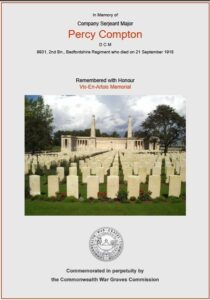
The 2nd Batalion of the Bedfordshire Regiment continued fighting battles on the Hindenberg line and it was on the 21st September 1918 in operations near Ronssoy that Percy was killed in action. He has no known grave but is commemorated on Panels 4 and 5 of the Vis-en-Artois Memorial in France.
Percy was one of around 1,540 officers and men who gave their lives for King and country serving in the battalion, and around 6,500 that were wounded in combat.
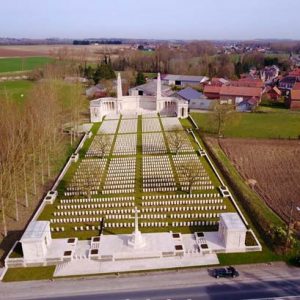
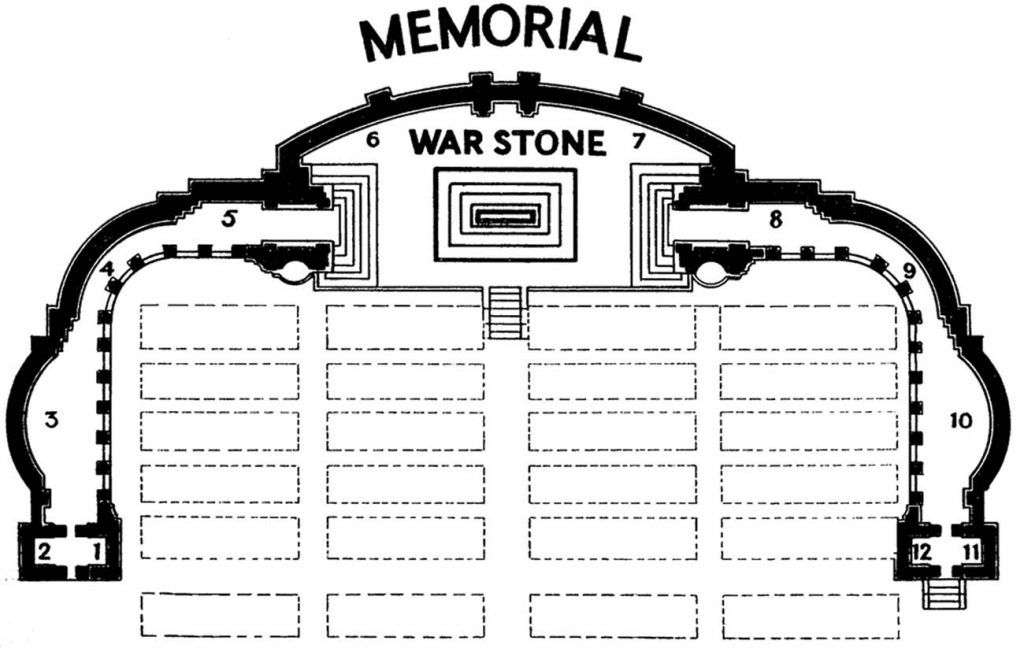
Vis-en-Artois and Haucourt are villages on the straight main road from Arras to Cambrai about 10 kilometres south-east of Arras. The Memorial is the back drop to the Vis-en-Artois British Cemetery, which is west of Haucourt on the north side of the main road.