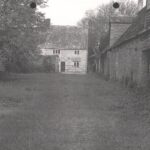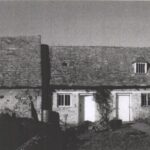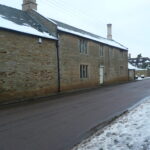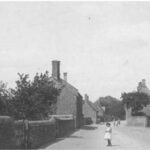
Manor Farmhouse is a Grade II listed property situated on the south side of Main Street. Although its origins date back to the 17th century, the farmhouse underwent substantial reconstruction in the late 19th century, followed by further alterations in the 20th century. The current owners have also carried out additional refurbishment. Like many of the surviving cottages in the village, the property was built for one of the Earls of Westmorland, who owned the Apethorpe Estate.
The house is constructed of squared, coursed limestone with ashlar quoins and what appear to be reused stone mullion windows in a mixture of two- and three-light arrangements. The chimney stacks feature pulvinated friezes, and the roof is finished with Collyweston and Welsh slate tiles. Although the property now has a front entrance, it is believed that the original access was from the rear, leading into a central stair compartment.
The bay attached to the eastern end of the house is thought by the Royal Commission on Historical Monuments (RCHM) to have possibly been a separate dwelling. However, the family who purchased and fully renovated the property in 1979 reported that this area showed no evidence of the typical facilities associated with an independent residence. It raises the question, could it have originally served as a barn?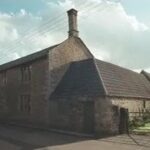
The outbuildings and former stable block, forming the lower bay at the western end of the road frontage and set at a right angle to the rear of the house, were constructed sometime in the 1700’s A recent planning survey suggested that the front portion of this building shows signs of previous residential use, ancillary to the main farmhouse. It also indicated the possibility that the building may once have been used as a small retail space, potentially a butcher’s shop.
The name “Farmhouse” itself highlights the property’s deep connection to farming and agriculture. According to a local resident, a beef herd was once kept in the rick yard and the buildings at the back of the house, while the stables housed three Shire horses, which were used to cart farmyard manure to the fields at the rear of the property. It wasn’t until the 1960s that tractors began to take over as the backbone of modern farming, marking the decline of traditional horse-drawn methods. Before this shift, however, Shire horses played a vital role in the day-to-day operations of the farm. In the 1970s, a calf unit was also added to the farm, reflecting its continued focus on livesto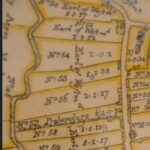 ck farming.
Who lived in Manor Farmhouse?
The earliest record of Manor Farmhouse that we can find dates back to the 1778 Enclosure map rent book, which lists an entry for John Dolby, who paid rent to the Earl of Westmorland for a farmhouse, barn, and homestead, numbered 58 on the map.
For over a century, pinpointing the exact census entries for this property has proven difficult, as Woodnewton did not assign specific addresses to its houses, only to prominent buildings like the Manor House, Cherryholt, and the Vicarage. It is not until the 1881 Census that we can definitively identify the inhabitants. Elizabeth Needham and her nephew, Frank Needham (formerly of the Mill), are recorded as the residents, both listed as farmers. By 1901, the property is occupied by Thomas Rippin and his family, with Thomas described as a “Horse Keeper on Farm” and his son as a “Milkman on Farm.” From this point onward, tracking the property’s residents becomes more straightforward, as additional historical records become available.
Frank Sharman is recorded as the next horse keeper, living at the farm between 1918 and 1922.
This property, along with the Manor House, Manor Cottage, and several other buildings and land, was sold by Henry Brassey to John Leonard in 1920. It can be assumed that John Leonard initially farmed the land himself, alongside his son, William Leonard. However, after the tragic loss of William in a riding accident, John Leonard began leasing the farm out.
In 1932, Arthur Moisey took over the tenancy and remained until 1936. After that, Charles Ashby, who had previously lived at Cheeseman’s Lodge, moved into Manor Farmhouse with his wife and three sons. He continued to farm the land with his son until he died in 1961. After his death, Jack Ashby, his son, continued to farm under the tenancy until 1977, when the Trustees of John Leonard’s Estate decided to sell the property. The Russell family purchased it in 1979 and undertook significant renovations. They lived at Manor Farmhouse until 2010, after which Tom and Molly Holmes, the current owners took over, continuing further improvements to both the house and its outbuildings.
2025