
Private Arthur Walter FOX
Northamptonshire Regiment 25186
Arthur Walter Fox was born in 1882 in Woodnewton to Wallis and Mary. Mary was also born in Woodnewton. Arthur grew up living with his parents and seven siblings in Bullimore’s Yard.
In 1909, Arthur married Annie Saunders from Fotheringhay. By 1914, they had three children: a daughter and two sons. During that period Arthur’s occupation was a builder’s labourer, whereas previously he had been a farm horseman.
When the War broke out in late July 1914, Kitchener decided, that more soldiers would be required, contrary to the popular belief that the war would be over by Christmas, he predicted a long and brutal war. A major advertising campaign was instigated and new volunteer Armies sprouted up all over the country.

Along with thirty nine other men from the village, Arthur decided to join the war effort. He was one of six colleagues who went along to Stamford in September of that year and enlisted with the 6th Battalion, Northamptonshire Regiment. As an experienced horseman¹, Arthur had agrteed to work with horses. The men were taken to Colchester as the 18th Eastern Division and after some training transferred to the 54th Division as army troops in the November.
The early days were somewhat chaotic; the new volunteers having very few trained officers and NCOs to command them, no organised billets or equipment. The units of the Division initially concentrated in the Colchester area but moved the following May to Salisbury Plain for final training. One of the highlights for the soldiersduring that period at Salisbury Plain must have been King George V’s inspection of the Division on 24 June.
Embarkation for France began a month later and proceeded to France on the 26th where the division concentrated near Flesselles. In Woodnewton, Arthur’s wife had given birth earlier that month to another baby.
Records show that in November, the weather deteriorated and over the next few months the soldiers suffered tremendous hardship. They experienced frozen ground, making the digging of trenches impossible, snow turning into rain, which made conditions very slippery.

By the January, British attacks had taken place against exhausted German troops holding poor defensive positions left over from the fighting in 1916. Some German troops had low morale and showed an unusual willingness to surrender.
The 6th Battalion diaries indicate that its soldiers then took part in the operations on the Ancre including Miraumont during the first week of February. Then the Brigade had another three days out of the line for rehearsals. On the night of February 15th/16th, the Battalion took over the battle front for the operations the following day. These were part of a big attack on both banks of the Ancre, to seize the high ground which would give observation over the upper Ancre Valley.
Arthur’s Battalion was on the south of the Ancre, below Miraumont. Orders had been given for all troops to be in position by 4.45am on the morning of the 17th. It was extremely dark (heavy clouds obscuring the moon that should have risen about 4.20am), the ground was very soft and slippery – the thaw, having just commenced, after nearly a month’s heavy frost, producing conditions that could not have been more unfavourable for forming up for an attack absolutely without trenches. Just before 4.30am the enemy sent up yellow and green lights, and a heavy barrage opened at once on the Gully and the ground immediately to the north. It was discovered later from captured German officers that they had learned full details of the proposed attack, and knew the approximate hour at which it was to be launched.
By dawn on that Saturday, there had been heavy casualties in this bombardment, especially from the Northampton Regiment. Private Fox had been killed. He has no known grave but is commemorated on the Pier and Faces 11A and 11D of the Thiepval Memorial in France.
Arthur was one of the estimated 6000 men from the Northampton Regiment not to return home.

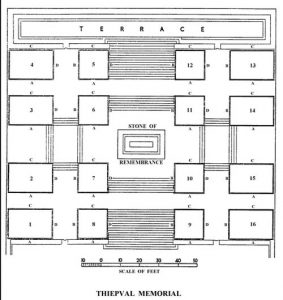
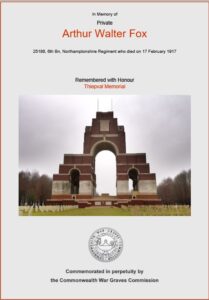
On the high ground overlooking the Ancre River in France, where some of the heaviest fighting of the First World War took place, stands the Thiepval Memorial. Towering over 45 metres in height, it dominates the landscape for miles around. It is the largest Commonwealth memorial to the missing in the world.
2013
Footnote
1. New information that Arthur was a groom, together with photographs were received in 2022 from June Edmond, great neice of Arthur.
2. Arthur is also believed to have been the “W. Fox” who was named on the Fotheringhay war memorial. His wife, Annie, was born and raised in Fotheringhay and her parents were still living there on the 1911 census)