
My mother’s father, Charles Barfield was born in Woodnewton, a Northamptonshire village, on the 3rd February 1867. In 1891, he came to Lancashire to work in his trade as a carpenter, moving eventually to Standish, where he built his home and lived for the rest of his life. Strangely enough, Grandad had no contact, as far as we were aware, with his brothers, his nieces and nephew and never returned to his birthplace during our lifetime. Even for a man as unsentimental as Grandad, this always seemed strange to me.
Yet even though our part of the family had no contact with Woodnewton, we were given a strong consciousness of the village in East Anglia from which the family came. Until his end, Charles Barfield enjoyed telling his stories of Woodnewton, so that it became to his daughter and then to his Grandchildren, a kind of Lost Eden from which the family had been exiled.
My son, Mark, and I have not yet been able to carry our research into the Barfield family history with any certainty any further back than the 1820s. The marriage certificate of Samuel Barfield senior is the earliest document we have f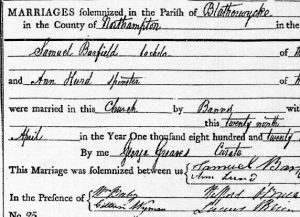 ound on my Barfield ancestors. Samuel was married on the 29th of April, not in Woodnewton, but in the neighbouring village of Blatherwycke, where he apparently resided as he is a “bachelor of this parish”. His bride was Ann Hurd who, although now a spinster of the parish of Blatherwycke, came originally from Ridgeway in Somerset.
Samuel is marrying quite late in life. He is now 39 years old and this is his first marriage. The Napoleonic wars had ended only eight years before with Wellington’s victory at the Battle of Waterloo. Many men in England must have been resuming their domestic lives in the early 1820s after the break of military service. Perhaps Samuel senior was one of these. Anne was more than ten years younger than her husband. If we believe the age she gave to the census taker who came around Woodnewton in 1841 she was as much as 17 or 18 years younger than Samuel, a girl of 21 or 22 years of age.
By the time their first child was born on the 2nd of May of the following year, they had moved to the pretty village of Kingscliffe near to Blatherwycke. However at some date before the birth of their second son, Samuel, in May 1826, the Barfields moved on again to Woodnewton, a village a few miles further on along the road to Fotheringhay. Here Samuel was the innkeeper at the Swan Public House in Town Street.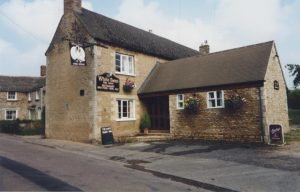
A photograph of the White Swan Inn taken in August 1996. In the background are the cottages where Jim and Joseph lived and where Joseph had his wheelwright’s business. At the date this photo was taken, one Barfield, Florence Barfield- still lived here
Samuel Barfield Senior tells us on the census form of 1841 that he was not born in Northants, which rules out either Blatherwycke or Kingscliffe as his birthplace and would seem to detach him from all the Barfields who lived in the southern end of the county around Titchmarsh. The name of Barfield, however, dates back many centuries in the old county of Rutland a little to the north of Woodnewton and my Granddad Barfield certainly spoke of Rutland.
Our speculation that the Barfields originated from Rutland
After a long period of research, we had been unable to find any record of the birth of a Samuel Barfield in the last two decades of the eighteenth century. Then Mark came across this entry in the parish records of Preston in Rutlandshire: “Samuel Barfield, born on the 18th of April 1784 to John Barfield and Elizabeth.” In these registers, the father of Samuel, John Barfield describes himself as a labourer but he signs with a good hand unlike many of his fellow villagers, who only make a mark for their name. The same church records also provided us with John Barfield’s marriage certificate; his wife’s maiden name was Elizabeth Biggs and the wedding took place on the 11th November 1771.
We get the impression that John Barfield was a well-known personality in the village. He was witness at over half a dozen weddings at this church between 1792 and 1811. When his daughter, Lydia Barfield, married Peter Muggleton on the 23rd of July 1803 at Preston Parish Church, the marriage certificate again shows John Barfield to be the witness.
The village of Preston would seem to have changed very little in the two centuries that have gone by. The old church stands surrounded by low thatched cottages in the same peaceful rural setting. On visiting this little Rutland village, it is not hard to picture John and Elizabeth Barfield with their family and their neighbours on the path to the church. One of the boys among their many children could have been Samuel, my Great-great-grandfather, who was to take the family name to Woodnewton in 1825 or 1826.
The second son of Samuel Barfield, whom I shall call Samuel Junior, was my Great-grandfather. He was married in September 1850 to Sophia B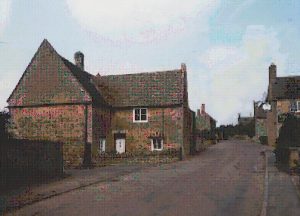 axter, the daughter of a Woodnewton farmer. In fact the Baxter farmhouse stood almost directly opposite the Swan inn. The house, in which my great-grandmother was born in 1824, still stands today relatively unchanged.
Samuel Junior was 23 years old when he married and his wife was three years older. Neither Samuel nor his elder brother had been satisfied to wait to take over the running of the Swan Inn and both had learned a trade. Joseph was a tailor, still living in Woodnewton, and he had an apprentice, George Silk, who lived in his house. Samuel was a time-served wheelwright.
Samuel’s wedding to Sophia must have been overshadowed by the death of his father nine months previously. Samuel Barfield senior had been buried at St Mary’s Church Woodnewton on the 16th December 1849. If his father was the Samuel Barfield of Preston, he would have been 65 years old when he died, but his age on death is given as only 63. This may cast doubt on the speculative Rutland family background, but age discrepancies were common in records of this period.
We can see the family names on the family tree but it is a pleasant exercise to imagine them at a family event. We can picture the congregation in Woodnewton Parish Church for the Wedding of Samuel Junior. In the front pew on the right-hand side at Samuel’s wedding sits Ann, his mother, now 53, with his sister, Hannah. The latter is 21 years old and is a bonnet maker. Hannah is living with her mother at the Swan Inn and is no doubt helping her to run it now that her father is no longer there. Samuel’s younger sister, Sophia, would have been 19 years old when he got married, but we have no record of her after the age of ten and she was not living with her mother in 1851. Perhaps she had gone into service, in which case she would probably be unable to attend; the imagination alone is left to paint in such detail now.
An active part in the service would have been played by Samuel’s elder brother, Joseph. His wife, Hannah was probably struggling to cope with her first baby, Jane, who was born in the same year. Hannah did not come originally from Woodnewton; she was born in Harborough in the county of Leicestershire. Life was not to be kind to Hannah. Two years after Samuel’s wedding, her husband was to die when she was pregnant with their second child. Joseph Barfield’s funeral was at St Mary’s on the 7th December, and his son, Joseph, was born five months later on the 8th May 1853 in Sawtry where Joseph’s family had since set up home.
One of Grandad Barfield’s stories of Woodnewton was of an uncle who had been attacked by footpads. Grandad described how the uncle, a fine man over six feet tall, had put up a good light. The ending of the story always disappointed me. The uncle was never the same again and he died a couple of years later, while he was still a young man. Perhaps it was Joseph who was attacked, returning from fitting a suit in a neighbouring village, with the payment in his pocket
Sitting in the family pew is another lady in her late fifties, who is also a member of the Barfield family. She is Elizabeth, and all we know at present of her Barfield husband is that he had been a labourer. What we do know about this Widow Barfield is that her birthplace was the neighbouring village of Nassington and that she lived, alone, two doors away from the Swan Inn, where she continued to live into the 1860’s.
After the ceremony Samuel took his new bride, Sophia, to his own house in Woodnewton, near to his mother’s inn, of necessity, as Woodnewton was a small village. The future as he saw it was to keep his wife and raise a family from his skills as a wheelwright
The childhood and youth of Charles Barfield in Woodnewton
Samuel Barfield was, however, soon to take over another responsibility. His m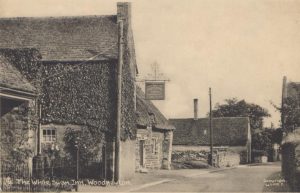 other, Ann, did not stay many more years at the Swan Inn. By the time of the census of 1861, her son Samuel had taken over the running of the inn. We do not know what had become of Ann, but the death of an Ann Barfield is recorded in the nearby village of Apethorpe on 18th December 1878 at the age of 83 years. The age once again does not tally exactly, but Ann’s age had varied every time she gave it. What is certain is that Ann Barfield is buried with her husband, Samuel in Woodnewton churchyard.
Life must have been hectic for Samuel’s family. Samuel had his wheelwright’s business to look after as well as the inn. Sophia too must have been busy with four young daughters to look after; Mary Jane was 8, Elizabeth was 5 (Aunt Elizabeth Barfield was still living on her own two doors away), Anne was 3 years old and the youngest daughter was seventeen months. In addition Sophia was expecting their fifth child. Their one servant was a young girl of thirteen, Mary Ann Morris. The 1861 census tells us that there was a seventeen year old apprentice, Harry Franer, also at the house. He came from Apethorpe and it would do credit to Samuel if his contact with this village was when a dutiful son regularly visited his mother.
At this time when, after eleven years of marriage, Samuel found himself with only daughters, he must have wondered to whom he would leave the wheelwright’s business when he retired. After the penury comes the glut. The baby who was born in 1861 was their first son, James, and he was followed by Joseph in 1863, by William in 1865, and finally by Charles, my Grandad, on the 3rd February in 1867.
By the time of the next census of 1871, Samuel had given up the struggle to do two jobs and he no longer describes himself as a publican. His profession is entered as “master wheelwright”. All the children are still at school except for the eldest, Mary Jane, who is now 18 years old. Samuel gets assistance from a fourteen year old apprentice, William Phillips of Wansford, and a journeyman, whose surname looks like “Ireson” and who, again, comes from Apethorpe.
When we look at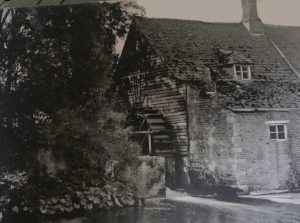 the closeness in the ages of the four brothers, we can imagine the fun the Barfield boys would have had, growing up in this little country village. Of the stories Grandad told me only the dramatic ones remain in my memory. This one from his boyhood is an unhappy one. One fine afternoon, Charles had gone swimming with his elder brothers, in the pond beside the watermill. Suddenly one of the boys shouted for help and disappeared under the water. The others went to retrieve him, but it got very desperate and Charles thought his brother had drowned before his eyes. The memory of this afternoon was with Grandad until his final days.
Samuel now had three sons working with him; both James and Joseph were now fully trained wheelwrights and the youngest, Charles was learning the same trade and showing great aptitude for it. Only William had chosen different work when he left school. He was now a butcher, although he was not too happy in this work. The problem for the father was that there was not enough work to permit all the sons to stay working in his wheelwright’s business.
The 1891 census, a decade later, shows a very changed situation. Samuel and Sophia’s address is now “Main Street” and the next house recorded on the census is the Horse and Jockey Inn. This, the map would suggest, meant that they had moved further down the road in the direction of Fotheringhay.
(My Barfield cousin, Jean Cunningham, has tried to help me understand the location of the three Barfield houses in Woodnewton but I am still a little unsure). 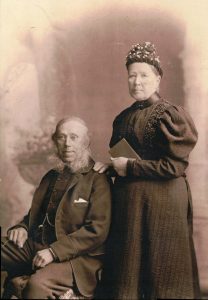 Portrait of Samuel Barfield and his wife Sophia circa 1900
The problem of the surplus craftsmen now seems to have been resolved. There are now only two wheelwrights: Samuel, who is of retirement age at 65 and Joseph. Another brother is there with them, but surprisingly this is William, who is no longer a butcher. He is a smith and fitter and no doubt uses his skills in the family firm.
In 1891, James and Charles Barfield are hundreds of miles away from the East Anglian village of Woodnewton. To find them, we have to look through the census returns of Lancashire.
A chapter on the Barfields who stayed in Woodnewton or who returned to live in Woodnewton
In the census of 1891, James Barfield is shown as a bachelor but later in the same year he returned to Northamptonshire to marry Fannie Elizabeth Spriggs, who came from the village of Sawtry, ten miles due south of Peterborough. Fanny was then 19 years old, nearly twelve years younger than her husband.
James brought his wife back to
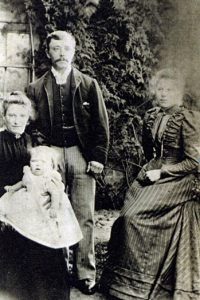 Standish and their first child, Annie was born there. St Wilfrid’s Parish Magazine records the baptism of Annie Elizabeth Barfield there on 31st August 1892. James and family did not choose to remain in Lancashire with Mary Jane and Charles. Before the birth of his second child in 1894, they returned to Northamptonshire. James and family went to live in a cottage in Woodnewton next door to his brother Joseph.
James Barfield in 1893 with his wife Fanny and his first child, Annie. On their right is his elder sister, Elizabeth, known to Cousin Jean Cunningham as Aunt Lizzie.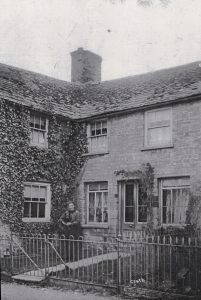
Among Grandad’s collection of pictures was this later photo of Fanny standing in her front garden
James did not go back to the family wheelwright/joinery business. For a time he kept a shop in Woodnewton, selling groceries and this was his stated occupation at the time of the 1901 census. Afterwards, he returned to his trade, becoming foreman carpenter on the Fotheringhay estate, a couple of miles down the road in the direction of Oundle.

This photo, (left) taken in 1902, shows Jim and Fanny in their garden in Woodnewton. Their four children are: Leonard, Rosa, Dora and Annie. Annie, the eldest, had been born in Lancashire, when her Dad was working on the Standish estates. A fifth child, Florence, was born in 1906
A few years after James’s marriage, his younger brother, Joseph, married Lizzie Spriggs, Fannie’s sister younger than her by two years. The Barfields must have visited Sawtry frequently to see their cousins, Jane and Joseph Barfield. Joseph Barfield of Sawtry, who was more or less the same age as Mary Jane, had been born several months after the early death of his father, also called Joseph, the elder son of Samuel and Sophia, whose story has been mentioned earlier.
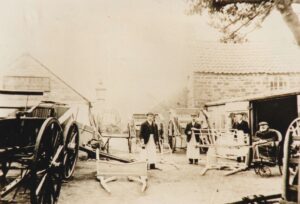 Joseph’s workshop was behind his house. Joseph with his bike stands outside his house with his wife Lizzie and his two children: Bertha, the younger daughter, and Evelyn. The other Barfield brother, William, was also working in the same trade, but away from Woodnewton.
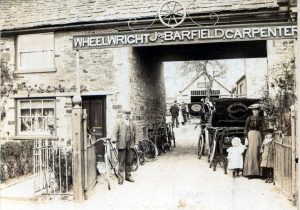
The next years were the Edwardian years and must have been the good years for the Barfields of Woodnewton just as much as for the Barfields of Standish. One sad event for the family came at the end of this first decade of the 20th Century, when the eldest daughter, Mary Jane Moss died on 23rd September 1909.
When the Great War broke out in 1914, only Leonard Barfield of the Barfields of Woodnewton or Standish was of an age for military service.
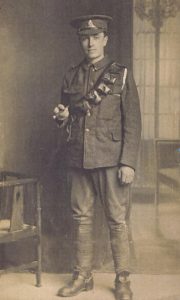 Mother’s cousin Leonard Barfield, circa 1916, in his Royal Artillery uniform
The postcard below was sent to my Grandad by his elder brother’s wife. She gives him news of her son Leonard, who served as a soldier in the First World War.
She says: Received your order with thanks – also letter. Have heard from Leonard- is moving & quite well. Will write you a letter later on. Your affectionate- FEB (her name was Fan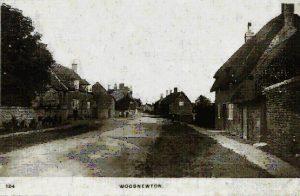 ny Elizabeth)
West end of Main Street with Church to the left in this photo.
The Later Years
As Auntie Katie told us on the postcard copied earlier, both brothers continued to work hard into their most advanced years.
Although Joseph was already 77 years old at the start of the Second World War, he still continued to run his business. In his shop, Joe sold batteries and paraffin. During the war he bought second-hand bikes and reconditioned them and then re-sold them to U.S. airmen. James, in his eighties, still had the steadiness of hand and keenness of eye to paint the red lines on the bikes.
In the war years, James also continued to use his joinery skills by making toys, at a time when children had little chance of buying toys in the shops.
A popular item for children was the small wooden wheelbarrows that they made. Jean was fascinated to see a photograph of the same barrows on display in front of great-grandfather Samuel’s workshop in the 1890. In fact, my brother Jim, Renee and I played with one for many years, made in Standish by Charles Barfield.
Joseph Barfield, an excellent carpenter, like his brothers, James and his Charles and his nephew Len was still carrying on his old trade as wheelwright, making wheels for the farmers’ carts.
My cousin Jean Cunningham, who spent the war years with her Grandad in Woodnewton, remembers the ceremony when her Great Uncle Joe, with the help of Uncle Len, put the iron rim onto the new cart-wheel he had made. A crowd of local menfolk would gather and they would help with buckets of water to douse the flames as the hot iron was fitted over the wood. More sombre was other joinery which Joe undertook – making coffins for the folk of the village.
In 1963, fourteen years after Grandad’s death, I visited Woodnewton for the first time. It was strange for me to go into a village that I had never been to before and find it so familiar. My Aunt Evelyn Barfield later took me out into the big back garden. There my Mother’s Cousin, Leonard, was standing among his vegetables in a large garden like our own, spending his retirement as his Uncle Charles and his own father had done.
Jean tells me that her grandfather, James, had the same green fingers as his youngest brother. With the help of his son, Len, he grew tomatoes and cucumbers and pot plants in his large greenhouse; these they sold in the village along with bunches of flowers from the garden.
Jim lived until the age of 95 years old and Fanny died four years later in 1960. Joseph lived until the age 91 years.
Information and pictures kindly provided by David Yendley, grandson of Charles Barfield.