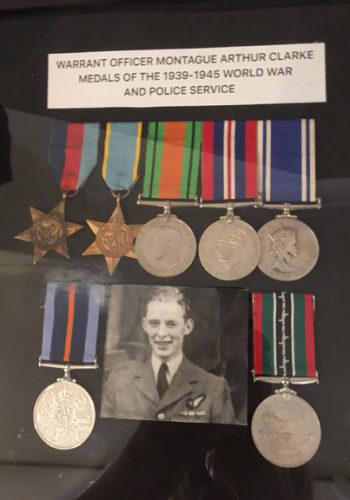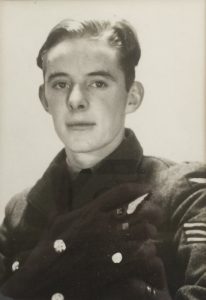
No. 1625027 SERGEANT MONTAGUE ARTHUR CLARKE
FLIGHT ENGINEER
102 CEYLON SQUADRON
RAF POCKLINGTON
YORKSHIRE
KRIEGSGEFANGENER No 2312
( Demobbed 1946 as Warrant Officer)
PREFACE
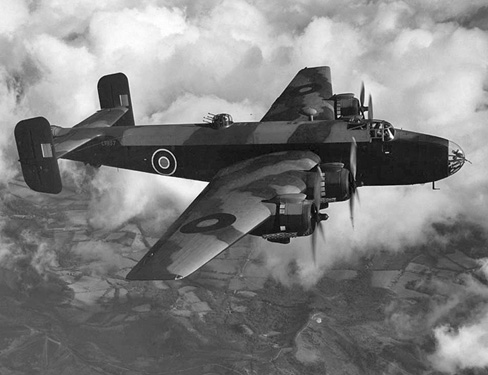
The memoirs you are about to read consist of my experiences of the last bombing raid carried out over Germany whilst flying in a “Halifax” heavy bomber with 102 Squadron based at Pocklington, a small town some 15 miles east of York.
I had first arrived at Pocklington with my crew during early October 1943 and was stationed there until failing to return from operations 19/20th February 1944. During this time I had completed 21 operations over enemy territory, including bombing raids, mine-laying operations and sea searches over enemy waters for crews of ditched aircraft.
Most of the operations I carried out with my normal crew but there were occasions when I flew with other crews whose Engineer was indisposed.
Some operations were hazardous, when we received heavy “Flak” damage and other mishaps, i.e. .engine failure. Others were described as a piece of cake.
Perhaps someday, when time prevails, I will write again of the actual operations on which I flew.
CHAPTER ONE
FRIDAY18TH FEBRUARY 1944
Reported to flight Engineer Leader’s office, Flt Lt. Kirkpatrick, at 0900 hours and was informed that our aircraft, Halifax “W” William was due for a major overhaul. We had previously experienced brake seizures whilst taxiing and a loss of power when on “take off” fully laden, so it was in for wheel change and new engines.
Flt Lt Kirkpatrick stated that as there were no spare aircraft our crew would be granted10 days leave commencing at 0001 hours on Sunday 20th February 1944. So I then with my Wireless Operator, Sgt “Johnny” Milner, went to the Orderly Room to draw our travel warrants, ration coupons and then to Pay Accounts Office to draw our leave pay. With Sergeant’s pay and flying pay I would normally draw just over £5 per week, but when going on leave all aircrew pay was doubled, due to the kind generosity of Lord Nuffield who stated that in view of the dangerous missions we carried out it was only fair we should be able to enjoy ourselves when on leave.
This also applies to the men of the Royal Navy in the Submarine Services.
SATURDAY 19TH FEBRUARY 1944
0900 hours reported to Flight Engineer Leader’s Office meeting all other Engineers. Flt Lt Kirkpatrick stated that “Operations” were on for that night. He then read out the list of crews that would be flying and which aircraft were to be designated to them.
My crew were designated to fly B “Boomerang”. This aircraft was normally flown by an Australian crew but they were to return from leave later that day and would not be back in time for the briefing which was at 2000 hours.
I would add that on the previous Monday, Tuesday and Thursday we had been briefed to attack Berlin but due to the very bad weather conditions these operations were cancelled at the last minute, once when we were actually in the aircraft with the engines running.
Flt Lt Kirkpatrick informed us that tonight’s operation would be an extra long one, (not naming the target), so therefore a long range petrol tank would be fitted in the bomb bay, cutting down our bomb load slightly. This extra tank would increase our petrol load from 1886 gallons to 2186 gallons. He also added we would have to use economical cruising to conserve fuel due to the distance we had to travel.
At 1000 hours I met my wireless operator, “Johnny” Milner and we both cycled out to the dispersal to “B” Boomerang. The Halifax was a Mark II series 1A and was brand new, having completed so far only one operation.
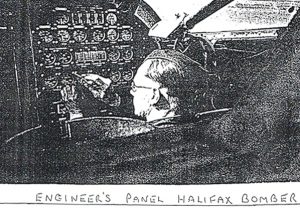
Whilst “Johnny” carried out his checks on his wireless and on the intercom system, including both gun turrets, I checked out that the long range tank was fitted properly and the electric pumps connected: next, the undercarriage and wheels. After this, with aid of the ground crew, I started each engine individually and ran them up, checking for magneto drop, oil pressure, boost and revs. After checking the engines other checks were made too numerous to mention but one important one was to check the oxygen supply for all the crew positions and also the portable oxygen bottles. Having a long trip we would be on oxygen for several hours that night.
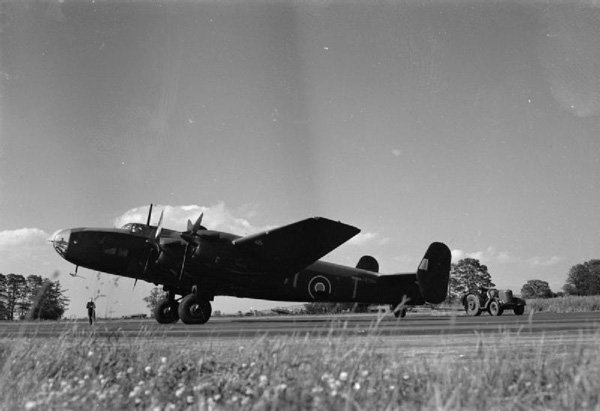
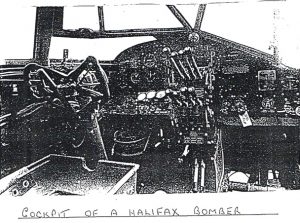
Next to arrive were the bomb trolleys with the bombs loaded we were to carry. Into each bomb bay in the wings six 1000 lbs high explosives were loaded. Into the main bomb bay next to lifted into their cradles were two 2000 lbs high explosive bombs each with delayed fuses, which meant they could explode days after being dropped. The rest of the bomb bay was loaded with containers of incendiary bombs, 36 in each container, 8 containers in all, making a bomb load of approximately 12,000 lbs. We would need full power that night to get off the ground with all that petrol and explosive on board.
My final check was to make sure all the bombs were loaded correctly and all electrical circuits connected to the bomb release. As we cycled away from “B” Boomerang to the mess for lunch I commented to Johnny about the state of the weather at that time; it was very cold, windy and overcast. This was similar to the weather we had bee having all the week. Johnny was saying he hoped operations would be cancelled again tonight.
At lunch in the Sergeant’s Mess we met other members of the crew. Sgt Bob Brett the navigator, Sgt Ian Dryden, a Canadian the Bomb Aimer, and Sgt Cliff Loosemore, the Rear Gunner, an Australian. Our Pilot Barry “Dixie” Dean, a Canadian and Bill Stenning, the Mid Upper Gunner, were Flying Officers so naturally they dined in the Officer’s Mess.
After lunch we just lounged around in the mess exchanging banter with other crews, cracking jokes, some playing cards for high stakes, or just dozing, there being nothing to do until 1900 hours, when we would partake of our operation meal which consisted of bacon and eggs.
Having nothing else to do we went back to our billet, a very cold Nissan hut some distance from the mess across the fields where we laid out our best blue uniforms, cleaned our shoes, ready for an early start Sunday morning for 10 days leave.
At 1945 Hours, having had our operational meal we then walked to the Briefing room where we joined our pilot and mid gunner. All crews on operations that night were now gathered and an armed guard placed on the door. The large map of Europe was covered with a curtain.
Next to enter was the Group Commander, Air Commodore “Gus” Walker, Base Commander Group Captain North Carter and Wing Commander Marchbanks. Once seated the Intelligence Officer in charge of the briefing pulled back the curtain. We could see the red tape stretched across the map, across the North Sea down through Germany to Leipzig; one or two moans could be heard but there were more sighs of relief, indicating it was not Berlin.
Normal briefing was carried out, i.e. 1000 bombers operating that night with intruder patrols operating against German night fighter stations. A small bomber force would attack Berlin shortly before the main attack on Leipzig. Our take off was 2342 hours.
Next came the Met Officer. He gave wind speeds of 100 mph, Westerly at 20,000 feet and cloud base at 2000 feet; some icing might occur climbing through the cloud.
After the Met Officer it was the turn of the Flight Engineer Leader Flt Lt Kirkpatrick. All the engineers were to start on fuel tanks 1 and 3, use 20 gallons, change to 2 and 4: whilst running on 2 and 4 70 gallons would be pumped out of the long range tank into tanks 1 and 3. Normal procedure would then be use for the rest of the flight.
After the main briefing every crewman was handed a line bag which contained an escape kit. This consisted of a small plastic case which contained a bar of concentrated chocolate, two packets of chewing gum, a tube of condensed milk, a packet of Horlicks tablets and a small rubber water bag for carrying water and purifying tablets. In another container were two silk squares approximately 2ft square on which were printed maps of Germany, France and Holland etc. (These were sold after the war as ladies scarves). There was also about £2000 in German, French and Swiss currency. This was to enable any airman who could contact the underground to help him to reach Switzerland. One point I have missed during the briefing: we were told if it was possible to reach the port of Lubeck by 26th February there would be a Swedish boat there. If there was washing hanging upside down on the stern, the Captain if contacted would help you to get to neutral Sweden. Taking out the escape kits from the linen bags, all our pockets had to emptied of everything: letters, photographs, money, wallets, even bus and train tickets, placed in the linen bags and handed over to the Intelligence Staff.
Briefing having been completed all crews moved to the crew room where flying gear was donned. First remove collar and tie, then put on thick white polo neck sweater, next long white woollen socks, quilted inner flying suit then outer flying suit with fur collar, fur lined flying boots, “Mae West” life jacket: finally parachute harness and flying helmet with oxygen mask and flying goggles attached. I had previously put on my flying underwear which consisted of a long sleeved vest and long johns. These were made of a mixture of silk and wool and were very warm. Also carried were three sets of gloves. First a silk pair, then a woollen pair and on the top flying leather gauntlets. Whilst flying I had to do a lot of writing filling in my logs, so I never wore gloves.
Moving to the door with my parachute and canvas tool box (which I would use if the need arose to carry out emergency repairs). I would collect a cardboard box containing 7 Thermos flasks filled with coffee, 7 small concentrated tins of orange juice, 7 bars of chocolate and 7 packets of chewing gum. These were our flying rations of which we would partake crossing the North Sea on our return journey.
We then boarded the crew buses and were driven out to our aircraft. First job was to carry out more checks, “pitot” cover off, starter trolley in position, bomb doors closed, climbing on board placed parachute, tool box and flying rations at rear of my flight position, also the pilot’s parachute: checked several large parcels containing “Window” (strips of silver paper), which I would drop at certain intervals to fox German radar. Removed aileron and control column lock, put automatic pilot into gear, turn on main fuel cocks and turn on tanks 1 and 3. Oxygen on, flight switch to “ground”, pilot informed ready to start engines. All engines were then started flight switch to “flight” each engine run up checking again magneto drop, boost pressure, revolutions and oil pressures: again all working perfectly.
We then taxied out of dispersal onto the perimeter track to join other aircraft taxying to the main runway. Eventually we turned onto the main runway. The pilot did his cockpit check, selected 12 degree flap; I closed my engine radiator shutters. We received the Green light from control. Engine and boost controls were pushed through “the gate” giving maximum revs and boost. Brakes were released and we started to roll, down the runway we charged and eventually our wheels left the ground. Time 2342 hours.
CHAPTER TWO
Climbing steadily the undercarriage and flaps were raised. I put in the undercarriage locks and then opened the engine radiator shutters. We continued a steady climb, also changing onto course. The engines were throttled back slightly to conserve fuel. We next entered the cloud the “Met” had forecast. Almost instantly I could hear something hitting the side of the aircraft. Looking out the window I could see that ice was forming and flying off the propeller blades. There was also ice forming on the engine intakes. The pilot then shouted we were losing power and the controls were sluggish. I immediately switched on the de-icing system to clear the propeller of ice and closed the radiator shutters. After about ten seconds power was restore and the propellers cleared of ice. I still had to run the engines with the radiator shutters closed and this meant running on hot air our fuel consumption was greatly increased. I had to enter all these details in my log and work out the increased fuel we were using.
At about 7000 feet altitude we broke out of the cloud and I was then able to open the radiator shutters and run on cold air. The pilot informed me that his controls were now normal so the de-icing was switched off. By this time we could see other “Halifax’s” around us all climbing steadily.
At about 20,000 feet altitude and just off the coast of Denmark and near to our first turning point, the navigator Bob Trett, informed the pilot that something was wrong. We were seven minutes too early at our ETA. Bob was working in the nose compartment with Ian, the Bomb Aimer. Together they were using the secret equipment, the “Gee Box” and H2S radar. “Gee” is a radio navigation aid which picked up radio signals from three ground stations and by using a grid system the exact position of the aircraft can be plotted. H2S is a centimetric radar blind bombing and navigational aid. This means that even with thick clouds a picture of the ground was displayed on the radar screen, so over the target the aiming point could be picked out even when covered by thick cloud as previously stated.
(It was later discovered that German night fighters were able to pick up the signals transmitted by the H2S, and home on to these signals and shoot the aircraft down).
Bob was one of, if not the best navigator in the squadron and I knew his findings would be correct. Almost instantly he had worked out that the wind speed given as 100 mph by the “Met“at the briefing was in fact 130 mph. Also the distance travelled had been in a shorter time. This was confirmed a short time later when the Wireless Operator picked up a signal from Bomber Command Headquarters stating that the wind speed had increased to 128 mph. BCH had received information from twelve specially selected aircraft on the raid whose navigators had worked out the wind speed, so Bob was on the ball.
Our course then changed to fly due South, we throttled back slightly, although still climbing; we had to lose the seven minutes gained. We eventually reached our bombing altitude of 23,000 feet. (About 4 miles high). Now over German territory the Bomb Aimer armed his bombs so they were now “live”. It was now intensely cold. The outside temperature recorded by the gauge on my instrument panel indicated minus 40 degrees Fahrenheit, in fact icicles were handing from my oxygen mask.
The next turning point was reached near Zwelle, (Holland), when we had to fly due West for Berlin. The object was to mislead the Germans into thinking we were attacking “the Big City”, as Berlin was known, so “they” would gather his night fighters over it to attack the bombers. Our plan was when 50 miles from Berlin to suddenly turn due South to Leipzig.
On making the turn due East towards Zwelle Bob informed the pilot we had lost three minutes. He then suggested we fly a “dog” leg course where we could lose the other four minutes. It was at this point near Stendal we had to release the marker flares to indicate to the following aircraft that this was the last turning point into the target, so we had to drop them exactly on time at 0230 hours. The pilot then to my amazement and to the others said “No we will fly direct to Stendal and lose the four minutes orbiting”. (Flying in a circle).
Now this is extremely dangerous due to the fact that our aircraft might crash into one of our own aircraft: also this would give the German radar operators time to vector their night fighters onto us. So we carried on to Stendal and commenced orbiting. I stood in astrodome looking out for any other aircraft and night fighters.
At exactly 0230 hours the Bomb aimer said ”All flares released”. Almost instantly there were several loud explosions inside the aircraft. Looking Starboard I saw a JU88 night fighter come from below and climb away. Bill Stenning, the mid upper gunner, had already swung his turret round and I could see his tracer bullets hitting its port wing. Suddenly the port engine of the JU88 burst into flames and it disappeared in a steep dive.
By this time our starboard engine had burst into flames. I immediately shut off the main fuel cock to this engine. Looking back down the aircraft I could see flames shooting out of the inspection panels in the floor above the bomb bay. We were well and truly on fire. I passed this information to the pilot who immediately gave the order to “destroy all secret equipment and abandon aircraft”. Next I heard two muffled explosions as Bob fired the detonations in the “Gee” box and H2S set, blowing their insides to pieces.
Reaching around the back of my flight panel I found one parachute, so I went forward to the pilot and clipped it onto his chest. Going back for my own parachute I found it had been buried under the parcels of “Window” which had fallen over due to the aircraft rolling about. Somehow there was no panic. I started to move the fallen parcels and the first thing I found was the cardboard box containing the flying rations so I picked up7 bars of chocolate and put them in my leg pocket of my flying suit. I thought they might come in handy. Eventually I found my parachute. I clipped it on my chest and then removed my flying helmet: (it had been found that if you bailed out with your helmet on the intercom lead which was about six feet long could become entangled in the parachute rigging as it opened, consequently hanging you).
By this time the interior of the aircraft was full of smoke and flames, so I did not hang about. The aircraft was now in a steep dive so I slid forward. When I reached the pilot’s position it was empty; he had gone before me. I carried on to the escape hatch in the nose; I sat on the edge and toppled forward. I cannot remember pulling the ripcord but I can remember receiving a terrific blow under my chin which almost knocked me out. This was the parachute being pulled out of its retaining clips. Next there was a terrific tug between my legs as the harness took the strain: (something else was strained as well). Looking up I saw the canopy had opened and I was floating down. Being windy I was swinging about quite a lot; my hands were almost frozen so I could not control the rigging lines. I then heard a very loud explosion and looking down I saw an aircraft had exploded in the air; it must have been “B” Boomerang. I had got out just in time. I could also see the ground was covered in snow and suddenly it appeared to be coming up at an alarming rate. Then bang, I hit the ground which certainly winded me. I lay still for several minutes to get my breath back. I then got up and instantly slid on my back. Again I tried with the same result. Scraping away the snow with already frozen hands I discovered ice. Looking around after eventually standing up, I discovered I had landed on a frozen lake about 50 yards from the bank. I gathered up my parachute and made my way cautiously to the bank where sat down to gather my thoughts.
The first thing that came to mind was that instead of walking into my home on leave there would be a policeman delivering an official telegram stating I was missing as a result of operations over Germany.
CHAPTER THREE
SUNDAY 20TH FEBRUARY 1944
After a few minutes realising the situation and the position I was in, I made up my mind that I would not give myself up but try to reach Lubeck. Rolling up my parachute I commenced to walk around the edge of the lake until I eventually came to what appeared to be some sort of cart track. I could also see, even though it was still dark, a forest where the track was heading. Reaching the forest I was disappointed to see it was not as big as at first thought so I carried on, still on the same track, hoping I would find somewhere to hide for the day, knowing daybreak would come and I might be seen.
Eventually I spotted what appeared to be a small hay stack some 200 yards from the track. I made way to it and after burrowing into it I spread my parachute over it to cover the hole I had made and settled in, becoming somewhat warmer than I had been. Soon I dozed off for a short time. I awoke dawn was beginning to break. I then ate one of the bars of chocolate I had taken from the aircraft and opening the escape pack I sucked one of the Horlicks tablets. Then looking out of my hide out I could see it was snowing quite heavily. That would at least help to cover my tracks. When it was fully daylight I opened the escape pack with the maps, finding Stendal, my last known position and with the small compass I found I had to head almost due North for Lubek. I also found since leaving the lake, I had been heading in the right direction. Knowing it would be best to stay where I was until dark; I burrowed down into the hay and finally fell asleep.
When I woke in the afternoon I realised I had to make some sort of plan, namely:-
1. To move only when it was dark.
2. To avoid all the main roads and use only the minor roads as a last resort, keeping to the fields. (In this part of Germany there were no hedgerows as we know in this country.
3. To avoid all villages and skirt around them.
4. To find a good hideout each night where I could spend the day.
Keeping to this plan I knew it would increase the distance I had to travel but I would have to put up with this to try to evade capture.
When dusk started to fall I carried out another part of my plan that was to camouflage myself. Using the knife in the inside pocket of my flying boot, I cut up some of the panels in my parachute, wrapping them round my legs and arms and tying them with some of the rigging lines and then making a kind of cape to cover my body and finally another piece as a turban. I was pleased with my handiwork, knowing I would blend into the snow covered country side.
Taking the floatation torch out of my “Mae West” life jacket I took the knife and cut the jacket to shreds. This, together with my parachute harness and the remains of the parachute I buried them in the hay. By this time it was dark so heading North I started to walk.
On I walked, every so often checking my track with the compass, using the torch. Being overcast I could not see the stars. Had it been possible I could have used the Pole Star. I passed several small farms but kept well away. Going was hard because of the snow and several times sank into a snow drift. I was feeling very cold, especially my feet, mainly because of my flying boots were wet. I had several rests but progress seemed slow. I eventually reached a forest so I thought that this is where I would spend the next day. I made my way well inside and finally laid down, partly under a fallen tree. I was shattered, due to the cold. I only seemed to doze for short periods and had to get up and moved about to get my circulation going. Once during the day I heard shouting but could see no one. Another bar of chocolate was eaten, also Horlicks tablets. Snow was eaten to quench my thirst. Darkness then arrived and I was glad to be on my way, but was worrying about my feet. I could hardly feel my toes.
Monday evening passed into Tuesday morning. Nothing eventful happened during the night. Once I came across a small river but it was frozen hard so I was able to make my way across it. Progress seemed painfully slow. Again I came across a large forest, so making my way inside I found a spot in a reasonably dense part. I then removed my flying boots and socks and began to rub my toes to get some circulation going. It was extremely painful. Feeling hungry, I consumed the bar of concentrated chocolate in the escape pack. Of course when I removed the wrapper I found it to be partly mouldy but I rubbed that off and ate the lot. I also sucked some of the condensed milk from the tube. Again during the day, I only dozed off for short periods, waking up very cold and stiff, longing for darkness so I could move on. Darkness fell and so I moved on. This time I could see the stars so finding the Pole Star I did not need to use my compass so often. Once I came across a road but decided not to use it, as it was too early in the evening and no doubt people would be using it, so I struggled on, keeping to the fields.
Tuesday passed into Wednesday. I was still very cold and my feet were now extremely painful. I passed one village, keeping well away from it. Looking for somewhere to spend the day I found at the side of a wood a large heap of bracken which had been cut and stacked. After digging my way in I found this much more comfortable and I was able to sleep a little better, but again the cold kept me awake most of the time. I was not feeling hungry but I sucked two Horlicks tablets. I think most of the day I was awake. I realised I had not seen another human being for some days. Darkness fell Wednesday evening. I found it a hard job to walk due to my painful feet but struggled on. It is surprising how determination can drive you on.
Thursday morning still overcast so the compass was constantly used, then it began to snow. I was wet, tired and hungry so another bar of chocolate was eaten. I felt very miserable. Then I heard the sound of a train and stumbling on I came across the tracks. This was also heading North so I decided to walk along the track. Here going was easier but every time I heard a train coming I lay on the side of the track until it had passed. This happened several times: my camouflage must have worked because I was not spotted. I then came across a small log shelter which I suppose was used by the railway workers. I found it unlocked and entering very cautiously discovered it empty. The only things inside were a few tools and a wooden bench. Here I sat for some time, glad to get out of the falling snow. It was time to move on, so off I went leaving the railway track and looking for somewhere to hide that day. It had also stopped snowing. I then came across an old brick built barn which had partly fallen down. One part of the roof remained so that was where I decided to stay. Going inside I saw a heap of straw stacked in the corner so I again burrowed my way into it. I began to doze off when I felt something move over my hand. I jumped up and then heard squeaking. The straw was full of rats. I spent that day sitting on the floor with a stick in my hand looking for rats. Darkness came and although I felt very tired and my feet were much worse I was glad to be moving.
Still keeping to the fields progress was slow but I was still heading North. Friday morning arrived. I had no idea how far I had travelled or of my exact whereabouts but on I went. By this time I was hobbling along due to my painful feet. At last I came to a road so I took a chance and walked along it. Twice I heard vehicles coming so I lay on the verge: both times they were lorries. I decided it was too risky so I left the road, back into the fields. Just as dawn was breaking I came to a large straw stack. Rats or no, this was where I was going to spend the day so I burrowed my way in and it was not long before I fell asleep. I woke sometime later due to the pain in my feet. I removed my flying boots and socks and I almost passed out when I saw my toes. They were horribly swollen and black. I had frost bite. I could not rub them to get any circulation; they were too painful to touch so I very carefully replaced my socks and boots. Then, to keep my strength up I ate another bar of chocolate and finished the tube of condensed milk.
Saturday passed and when dusk arrived I made another decision. I would spend the night in the straw stack and build up my strength for Sunday night’s trek.
Dawn on Sunday arrived. I had evaded capture for a week but I knew I could not go on much longer. I tried to stand up but could not stand on my feet. I then knew if I was to survive at all I had to give myself up, but how? I removed the pieces of parachute I was wearing and with the escape currency, maps and compass I buried them deep in the straw. No doubt later a German farmer would find himself much richer.
I at last managed to stand up and I could see about a quarter of a mile away a farmhouse. For what seemed like hours I stumbled along and finally arrived there. I knocked on the door and a woman answered. She took one look at me, screamed and ran inside. Next two men came to the door. I raised my arms and said “English flyer”. They then grabbed me, dragging me inside and knocking me to the floor. Then they started a heated conversation which I could not understand. After a time I was allowed to sit in a chair and the woman gave me a cup of milk. She also handed me a mirror. What I saw shocked me. Besides being pale and haggard and seven days growth of beard, my chin and throat were covered in blood. This was caused by a deep cut in my chin which had obviously been caused by being hit by the parachute when it opened. The two men then went outside and shortly afterwards came back with a horse and cart. As we drove away I thanked the woman for the milk.
After a long and bumpy journey we eventually arrived in a town. Being Sunday people were going to church. The two farmers were shouting “Englander Flieger” (English Flyer). People stopped and looked and many raised their fists and shook them at me.
We then stopped outside a large house and I was eventually taken inside to the kitchen where it was indicated I should sit down. A very large and pompous man spoke to me in German, which I could not understand. He seemed to lose his temper and started shouting at me. I just sat still not saying anything. He then went out and returned with a young girl, very blonde, and about 14 years of age. She spoke to me in English. She asked me several questions but I told her I could only give my name, rank and number. This she conveyed to the pompous man, who I learned was her father, the “Burgomeister”. I then asked the girl what town I was in. She informed me it was “Peilburg”. When I asked how far away Stendal was she replied about 35 miles. I was disappointed: I thought I had travelled much further. She also informed me that the Luftwaffe had been notified and they were on their way to collect me. She bid me goodbye but before she went I gave her the remaining bars of chocolate I had. She thanked me very much, curtsied and left. I think giving her the chocolate impressed the “Burgomeister” for he seemed more amiable towards me.
After a time, being very warm in the kitchen, I must have dozed off. The next thing I knew was a voice shouting “stand up”. I opened my eyes and saw a young Luftwaffe officer standing in front of me with two armed guards behind him. I struggled to my feet and the next thing was a vicious cut across the face when the officer hit me with his gloves shouting “You salute a German officer”. He then said something to one of the guards who stepped forward and with his help I had to remove my flying suit. This done he searched all the pockets but not one item could he find. This obviously annoyed him. He asked me where my escape kit was. I said “I threw it in the river”. This seemed to make him worse, the thought of losing £2000. After a while I was taken outside and placed in a car between the two guards. It was dark now and after what seemed a long journey we pulled up at what appeared to be a Luftwaffe station. I was taken to the guardroom and placed in a cell. About 30 minutes later I was taken from the cell into a basement in another building, still with two armed guards. I was given a straw pailliasse and a blanket and told I was to sleep there for the night. Sometime later another young Luftwaffe officer came in. I could see by the wings on his chest he was a flyer. He also wore the “Iron Cross”. I struggled to my feet and saluted. He was a flyer for which I had respect, not like the first one. He spoke perfect English. He did not ask me any question regarding my squadron etc, only my job and how long I had been flying. He then put out his right arm and tapped it. He said “It is wooden”, it was shot off by one of your night fighters over Hull. When he asked if I wanted anything I told him I had not eaten for some time. He spoke to one of the guards who went out and returned shortly with a small pail of vegetable soup: the first hot food I had eaten for seven days. I also told him about my feet. He said he would try to arrange something but nothing happened. I finally went into a sound sleep after bidding him goodbye.
CHAPTER FOUR
MONDAY 28TH FEBRUARY 1944
Awaking early in the morning I asked one of the guards, more by sign language, if I could have a wash. He shook his head and said “Nien”, meaning “No”. This was no doubt part of the treatment to keep one’s morale as low as possible. After a time I was given a mug of “Ersatz coffee and two slices of black bread spread with some sort of grease. I later learned this was “Ersatz” margarine. The coffee was vile and so was the bread. About mid morning I was taken from the basement to a very large room. In this room were several long rows of typists facing a raised platform on which sat a Luftwaffe officer at a desk. I mounted the platform and saluted him. He then said “Where are your escape aids?” I told him I had thrown them in the river. “Have you any compasses?” was the next question. I replied “No”. Next I was told to remove my battledress blouse. He then commenced to cut off every button. He seemed very pleased when he found one with a small spike attached. (I should explain all aircrew carried two buttons sewn on their uniform, one had a small spike and the other a white dot. When the one with the dot was balanced on the spike the dot swung to the North – it was a compass). He asked me where the one with the dot was. I told him it had come unsown from my epaulette previously and I had not sewn it back on. This was true. He called me a liar and told me to remove my trousers, which I did, off came the buttons. Next to come off were my socks, flying sweater, shirt and vest and I was left standing in my long Johns. I also noticed a silence had descended on the room. Turning I looked at the women and saw everyone had stopped typing and was staring at me. The thought then crossed my mind that if my long Johns were to come off I would give them a rear view and nothing else. Much to my relief I was told to get dressed. By this time I had a smile on my face which annoyed the officer. Little did he know I had a small compass sewn into the back of my battledress collar and he had missed it. I was then taken back to the basement and after a time was given some more vegetable soup, which I quite enjoyed. About mid afternoon another officer came in and in broken English told me I was being moved. I was taken outside and placed in a car with the officer and guard. After a short time we entered a large built up area and I could see very few buildings were intact, the bomb damage was considerable and as we drove on the damage seemed to get worse. The officer turned to me and said “Berlin”. At one point I saw the body of a man hanging by a rope around his neck from a lamp post. As we drew nearer I could see the body was wearing an American flyer’s uniform. This confirmed the report that German civilians were hanging British and American flyers who bailed out over Berlin.
Eventually we arrived at a large railway station which read “Potsdam”. There seemed to be thousands of people clutching bundles and cases all intent on getting out.
The officer left the car and returned shortly with four military policemen identified by a large metal plate hanging around their necks. I got out of the car and was told to put on the German guard’s knapsack. The straps on the front covered my flying wing which indicated I was aircrew. Then with my escort surrounding me I was taken into the station along the platform. People were shouting and shaking their fists and I was glad when we boarded the train. I was led to a compartment where sat an armed German. Opposite him sat a man dressed in a long brown overcoat and green trousers. I sat next to him and after a time he said in an accent with a Canadian drawl, “Cheer up buddy it’s not too bad”. I then discovered he was a Canadian airman shot down some weeks ago and being wounded had been in hospital and was just released. He also informed me we were being taken to a Luftwaffe Interrogation Centre at the town of Oberusal near Frankfurt on Main. During this time several civilians and military personnel tried to enter the compartment to claim empty seats but all were refused, at times with a gun in their ribs from our guards. The corridor of the coach was jammed full of people. At last the train pulled out but progress was very slow. Looking out of the window I could see the bomb damaged buildings. It was devastating. Leaving Berlin the speed increased. One of the guards went out and shortly returned with a young woman who was carrying a baby and a little girl. He indicated she should take the empty seats. I got into conversation with the Canadian but not once did we discuss with each other our squadrons etc, because we knew the Germans planted English speaking men disguised as allied airmen to try to get information. The Canadian then produced a Red Cross parcel and taking out a large bar of chocolate he shared with the guards and the woman, the largest piece going to the little girl. This seemed to make the situation more sociable and relaxed. We travelled on through the night very slowly at times and eventually reached Frankfurt on Main as dawn was breaking. Here we had to transfer to another train for”Oberusal” and on reaching there we boarded a tram car, having to stand on the outside platform, not being allowed inside with the civilians.
last Dulag Luft was reached. It consisted of wooden buildings surrounded by barb wire fences and watch towers. I was taken inside to an office and again stripped and searched: again my compass was not detected. Next I was taken to the cell block. This was along a corridor with cells either side. I was placed in a cell which measured 7ft x 5ft, a window with frosted glass and barred. There was a wooden bunk with a straw paillasse and a thin dirty blanket. On the wall was an electric radiator and a chamber pot under the bed. On the wall was a lever with a notice stating “If you required attention to pull the lever”. On doing this a flap fell outside in the corridor attracting the attention of the guard. This was often ignored.
A little later a warder came to my cell. He handed me a form headed “International Red Cross”. It asked numerous questions about which squadron, where based details of crew, commanding officers etc. I only filled in the part which said name rank and number. When the warder returned he saw what I had written and then threatened me if I failed to fill in the rest. I told him under the Geneva Convention I was only obliged to give my name, rank and number. He then said “You will suffer” and slammed the door closed.
After about an hour I noticed it was getting warm. I put my hand towards the radiator. It was very hot. The heat increased until eventually I was lying on the bunk with just my long johns on and sweating profusely. After about two hours it started to get colder. The radiator had been switched off. I ended up fully clothed with the blankets wrapped around me, shivering like hell. This treatment continued all the time I was in the cell. Mid day a warder brought me a mug of watery soup and later in the evening two slices of black bread spread with the vile grease. I saw no one for the rest of the day.
WEDNESDAY 2ND MARCH 1944
After spending a very uncomfortable night with the heat going on and off I was given two slices of black bread with grease and later told to empty the chamber pot which I used during the night. Only one prisoner was allowed to do this at a time. This was to avoid any contact with other prisoners. During the morning the warder arrived with the bogus Red Cross form. Again I refused to fill it in. This time when he went out, he said “You will stay there until you rot”. During the afternoon when stripped off and laying on the bunk, a warder arrived and told me to get dressed. I was not allowed to put on my flying boots which had previously been taken from me and left outside my cell. Hobbling down the corridor leaning on to the wall because of my painful feet, I was passed by a pilot Squadron Leader. He could see from my appearance the pain I was in and said “Chin up lad”. That lifted me quite a lot. I was then taken into an office where sitting behind a desk was a Luftwaffe Officer. He must have noticed my condition because he told the warder to get a chair for me to sit on. He told me in perfect English he knew England quite well, having been educated at Winchester before the war. He then asked me the name of my squadron. When I told him I could not answer that, he replied “Well I will tell you”. With that he picked up a large folder from the desk and opening it commenced to tell me the names of all the Commanding Officers, which flight I was attached to, my aircraft letter, finishing with my pilot’s name and all the rest of the crew. He knew everything. I replied “some of it is right, but a lot is wrong”. His only reply was “We know everything”. After asking several more questions, which I refused to answer, he told the warder to take me back to my cell. Once inside I sat pondering for a very long time and came to the conclusion that someone in my crew had been talking. (Later when I met Bob Trett, Johnny Milner, Ian Dryden and Cliff Loosemore in the prison camp I challenged them about this. They all stated they had had the same experience).
THURSDAY 3RD MARCH 1944
Just after midday, having suffered the same treatment during the night, I was handed my flying boots and told to put them on. I was then taken outside and put into a lorry with three other RAF men and 36 American airmen. We were told we were being taken to a transit camp in Frankfurt. On arrival I found this camp to consist of a few wooden huts surrounded by the usual barb wire fences and towers. It was run mainly by British army POW’s.
First we were given a cardboard box – compliments of the American Red Cross. Inside were two pairs of underpants, vest, shirts socks, handkerchiefs, soap razor, etc. The underwear was of a very light material, more suited for the tropics; still it was very welcome. After shaving I had a shower and with my new underwear I felt very refreshed. Next came a meal of corned beef, potatoes and beans washed down with a mug of tea. I also enquired about medical attention for my feet but was told I would have to wait until I reached the main camp. One thing I vividly remember about that camp was a raid on Frankfurt by the RAF. It was only a small force but with bombs dropping and ack-ack guns firing I would have given anything for just a small hole to crawl into. It was better dropping bombs than being on the receiving end.
CHAPTER FIVE
FRIDAY 4TH MARCH 1944
After a very sleepless night due to the air raid and my painful feet, breakfast was dished up. This was called “Glop”. It consisted of broken biscuits, raisins, dried milk all boiled up to make a kind of porridge: (All Red Cross food). After breakfast we were paraded and counted and then told we were being moved to a permanent camp, Stalag Luft VI, at a place called Heydegrug, a small town near the North East coast of Poland, which was once called Lithuania. Each man was given a Red Cross food parcel which was to last him the journey. Climbing aboard a lorry we were driven to a railway siding where we boarded a coach-cum- truck, which I can only describe as follows:-
Inside there were rows of wooden seats with no tables, all windows were heavily barred, one third of the coach was divided from the rest by an iron grill in which a door was fitted. This small compartment was for the use of the German guards whilst the rest was for us prisoners. Our part of the truck had no exit door whatsoever. In the guards part was a wood burning stove which used to heat the truck slightly and also to boil water for the Ersatz coffee with which we were issued, this being the only hot refreshment we had during the whole journey. In the corner of our part of the truck was a tin bucket which was all the sanitary arrangements for 40 men. There were no spare seats, no room to stretch your legs and certainly no room to lie down. We sat in the railway siding until very late in the evening when we were coupled to a train and began to move. (I would point out we were not attached to a special train only one that was going in our direction). When this stopped we were uncoupled, shunted into a siding and left until another train arrived heading North East. This is the reason we did not arrive at Heydegrug until 10th March.
SATURDAY 5TH MARCH 1944
About mid morning we were again coupled to a train and off we moved: it must have been a goods train because most of the time we travelled very slowly. By this time I had palled up with the other three RAF Sergeants, all aircrew, so we sat together. It was decided to share our Red Cross parcels in order to make them last longer because we knew by the progress we were making we would be on that coach for some time. The Americans, although friendly, seemed to keep to themselves. I will never forget one American who I became friendly with: he had been badly burned about the face when his aircraft caught fire. He constantly received treatment in a German hospital but what was most noticeable was he had no eyelids so that when asleep his eyes were just staring. Even with this disfigurement he was quite jolly. Darkness arrived and once again we were shunted into a siding. After a time we settled down to try to sleep. This was almost impossible sitting upright on a wooden seat. Suddenly we were awakened by anti-aircraft guns firing that seemed very close. Next we heard the sound of aircraft and then the bombs began to fall, some very close. One of the guards then informed us that we were in Berlin. This lasted for about 20 minutes. During the raid, by looking out of the window, we could see the flares dropping and also large fires burning.
Night Passed and on Sunday morning we could see the large pall of black smoke rising over the city. About 10am that morning the “ack-ack” guns began to fire again. Looking out the window we could see in the clear sky high above formations of “Flying Fortresses” and “Liberators” and they seemed to be heading straight towards us. Suddenly they turned and again we heard explosions as the bombs hit; they again seemed very close. We could see several aircraft falling in flames and some parachutes floating down. Some 30 minutes later all was quiet.
During the afternoon we were again coupled to a train and we began to move. We came to what appeared to be a railway marshalling yard. This had been hit in the morning raid. There were engines on their sides, trucks blown to pieces, hundreds of bomb craters and tracks torn and twisted. Also noticeable were the hundreds of men and women, obviously Russian slave labour, who were filling in the craters and relaying tracks.
We progressed painfully slow and began to suffer discomfort. The stench was unbearable. None of the windows could be opened and our backsides were sore due to the wooden seats. Monday and Tuesday passed, with nothing of interest to mention. Progress was still stop and go. Once we stopped during daylight and the guards allowed four men at a time to go outside to stretch their legs and get some fresh air. By this time I think we were in Poland, because numerous troop trains were passing us loaded with tanks, heavy guns, armoured vehicles and lorries, obviously going to the Russian front.
WEDNESDAY 9TH MARCH 1944
This morning we were told we were in Poland and should reach our destination tomorrow, Thursday. At one point we were shunted into a siding again to wait for another train. About 50 yards away was a train comprising a number of closed trucks. This in turn was surrounded by numerous armed guards, some with dogs. One of the Americans commented on the badge the guards were wearing on their lapels. He stated they belonged to the “Waffen SS” the most dreaded troops in the German army for the atrocities they carried out. At times we could hear screams, shrieks, shouting and moaning coming from inside the trucks: the guards paid no attention. Eventually this train moved out. (It was not until after the war when certain details came to light did we realise that this train must have been loaded with victims destined for the concentration camps, of which there were many in Poland.
THURSDAY 10TH MARCH 1944
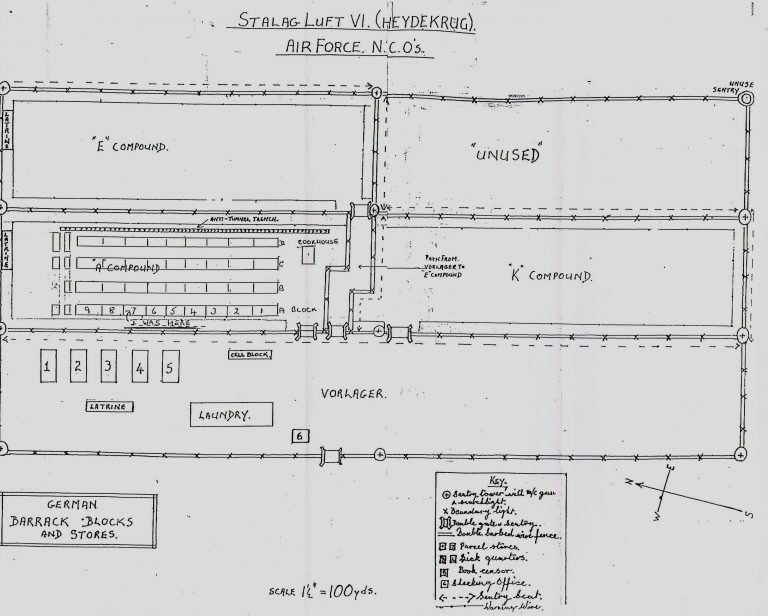
After travelling most of the night the train eventually stopped. We were told this was Hedygrug. We sat still for some time and eventually a number of other guards arrived. We then dismounted with the guards on either side of us we were marched to the prison camp. Due to my feet I was supported on either side by my RAF colleagues. After marching about 5 kilometres through the snow we arrived at Stalag Luft VI. This was a large camp comprising five compounds. The front compound was known as the “Vorlager”. In this were situated the sick quarters, laundry, other offices and the cell known as “The Cooler”. “A” compound was the main compound in which were four brick buildings A, B, C, and D. These were each divided into nine rooms. There was also the main cookhouse, camp theatre and other offices. This compound contained all the RAF personnel.
Next was “K” compound, much smaller and again with RAF personnel. “E” compound contained all the American airmen. This was fairly new and not as well established as “A” compound. “C” compound contained no buildings and was empty, no doubt for further expansion.
Once inside the “Vorlager” we were photographed and documented. I was given the number 2312 and allocated to room A7. Next we were handed over to RAF personnel. Due to my condition I was taken to the sick quarters where I was examined by a British Army Officer doctor, Captain Pollack
After studying my feet for some time he commented, “You have frost bite very bad but I don’t think we shall have to amputate your toes”. This lifted a great load off my mind. He went on to say “It will take a very long time and you will be in great pain but you will survive”. Next he spread some ointment over my toes very gently and then bandaged my feet. He also gave me another pair of thick socks and told me to wear them in bed at night.
I was taken to room A7. This was a large room with twenty two tier wooden bunks down either side with very little space between each bunk. In the centre of the room was a large brick built stove with a metal top on which were several tins of water. The rest of the room was filled with rough wooden tables and forms to sit on. I was first greeted warmly by a sergeant pilot who said his name was Wilf Fixter and was room leader.
(I later learned that Wilf was on the escape committee called “Tallyho”).
He had been a prisoner a very long time. I was shown to an empty bunk which had a straw filled paillasse and two blankets. I was also given a tin plate, mug and a knife, fork and spoon. I was then overwhelmed by other inmates of the room who bombarded me with questions regarding what squadron I was from, where I lived how the war was progressing and would the second front start soon.
After lunch (a meal prepared by the cookhouse), I was introduced to an RAF wireless operator from another room named Charlie Ware. Charlie said he came from Kettering, which was near to my home town of Desborough in Northamptonshire. During the conversation mostly about Kettering, I noticed Charlie asked me several questions such as the name of the Police Superintendent at Kettering, which I knew was Chapman. His son a pilot in the RAF had been awarded the George Cross posthumously. Sometime after Charlie left Wilf came back into the room. He said to me “You’ve passed”. He then explained that Charlie had been interrogating me to make sure I was not a German planted in the camp to gain information. I was quite relieved by that.
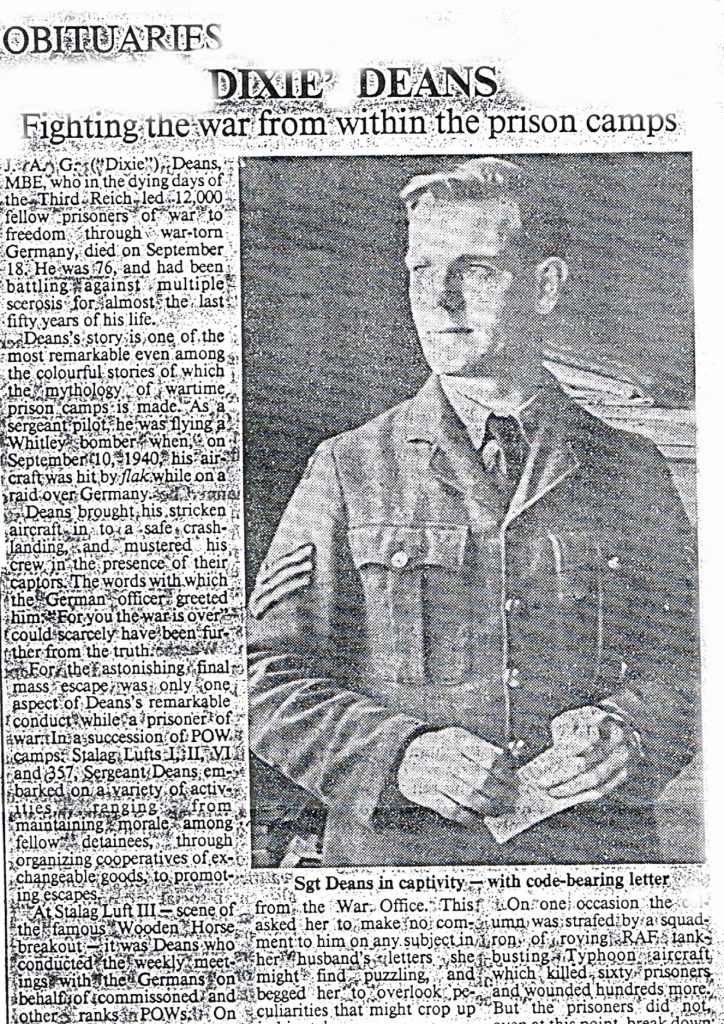
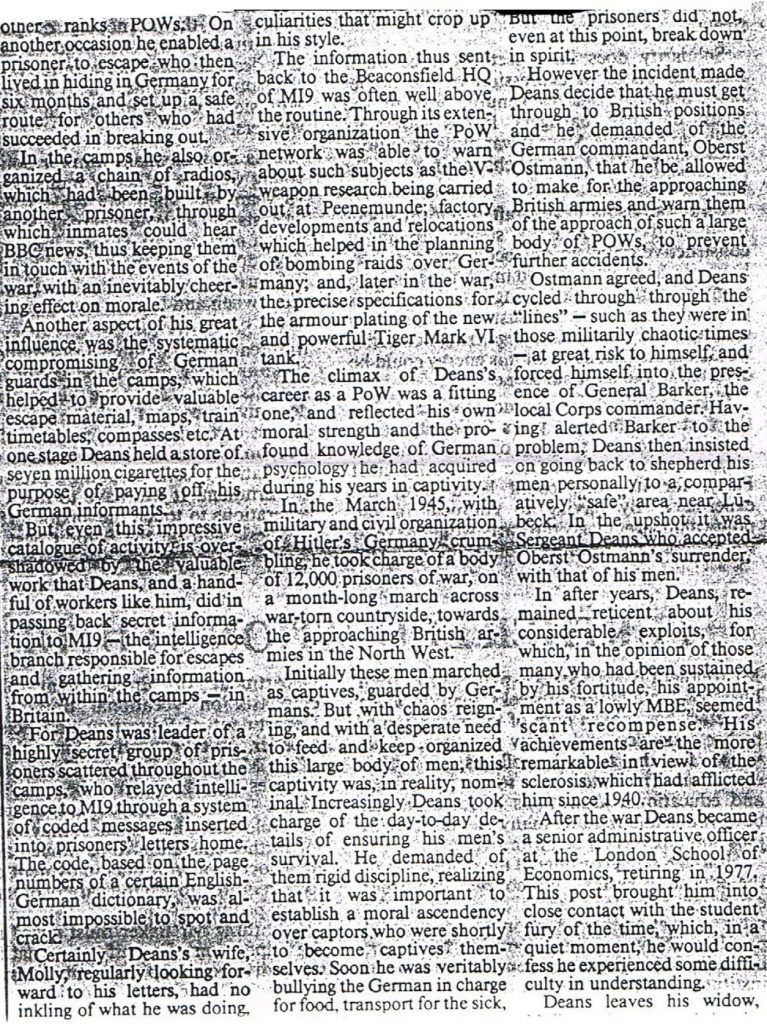
Next I was introduced to “Dixie” Dean, the camp leader. Dixie ran the camp with a rod of iron and was much respected by the Germans. His exploits are mentioned later. I was also able to find the rest of my crew, Ian Dryden, Bob Trett, Johnny Milner, and Cliff Loosemore. They were most surprised to see me, all thinking I had gone down with “B” Boomerang. I also learned of their experiences at Dulag Luft and how they had been surprised how much the German Intelligence knew of our Squadron
CHAPTER SIX
I guess in one way I was lucky. Weeks before I had been collecting the thick string that tied the Red Cross parcels so on going back to my room and finding the string intact I made a string hammock which I suspended on the wooden supports of my bunk. It took some time to get used to but it was far more comfortable than sleeping on five boards. I gave away my boards. Some of the guys put their boards into one bunk and slept together. They must have been very cramped.
During the day we could see the American 8th Air Force on its way to bomb targets deeper in Germany. Some bombers were shot down but we could also see numerous German fighters coming down after being attacked by the American fighters. During the night the RAF came over. All the lights in the rooms and on the boundary wire were switched off until the raid was over.
Close to Stammlager 357 was a large tank training school with several three storey brick buildings that looked like barracks. Many times during the day the tank men would pull up close to the boundary fence in the tiger tanks and sit taking the “Mickey” out of us, especially when playing football. One particular night, all the lights went out, indicating another air raid and then bombs began to fall very close. This went on for about 15 minutes. Next day we could see the tank school had been the target. It was absolutely flattened. We did not see any more tanks around the camp after that.
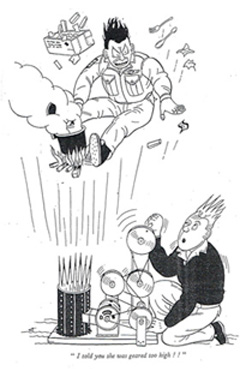
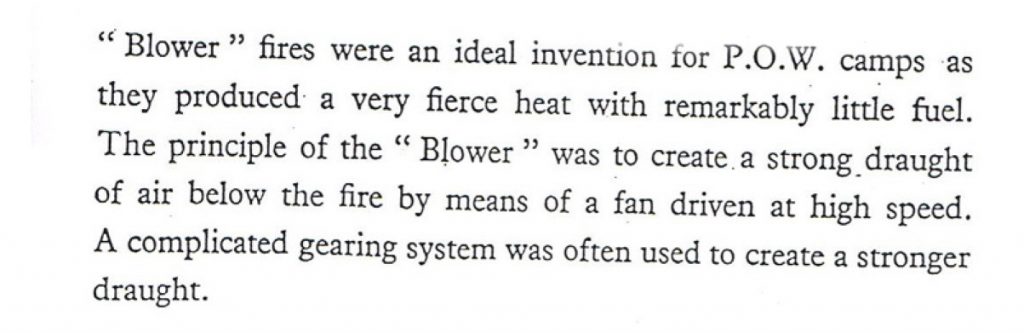
One important item in camp life was the “Blower”. This was a contraption built of wood and tin and used for boiling water etc. The principle was thus: – fitted to a wooden frame was a wooden wheel which when turned by a handle, turned into an enclosed fan by means of a string belt drive. The fan forced air along a tin tube into the bottom of the firebox, also made of tin. The fuel used was pieces of cardboard and wood and sometimes ashes gleaned from the dump outside the cookhouse. The fire was first lit in the bottom of the firebox and as fuel was added the wheel was turned. The air which was forced into the bottom of the firebox soon had the fuel burning and it was only minutes to boil a can of water, in fact several cans of water could be boiled for very little fuel. Some blowers were quite elaborate, using a series of gears. Very little effort had to be used to turn the wheel. If turned too fast it would blow the fuel out of the firebox. All the blowers in the camp, of which there were hundreds, were all made by the prisoners themselves with very primitive tools which were shared, such as a knife which had a blade to make it into a small saw. Scissors were used for cutting the empty food tins. Nails were made from barbed wire and so on.
Some men were very skilful. One in our room was a tinsmith in Civvie Street. With several empty tins he constructed a washing-up bowl, square shaped using nothing whatsoever to seal the joints, only a piece of thick wire to strengthen the outside edge. When filled with water not one joint leaked. Others were equally skilful in other fields. They would cut a raw potato in half, leaving to dry and harden, then with a razor blade and penknife they would copy a German stamp to such a fine degree it was impossible to tell the difference. These were used on forged documents to help would-be escapers.
Being all aircrew NCO’s we were not allowed to work outside the camp. This rule was once relaxed and four men from each room were allowed out, after signing a parole stating that we would not escape, to pick potatoes for a German farmer. Naturally they came back each day with their trouser legs and inside of their shirts full of “spuds”. These were shared with everyone else in the room.
Once again we were issued with a Red Cross parcel between four. Then we hit a bright idea. We would make a Christmas pudding to be eaten on Christmas Day. We grated several raw potatoes and placed them in a rag. All the moisture was squeezed out, leaving a kind of dough. To this we added several biscuits finely crushed a packet of raisins, dried milk, sugar and a small amount of cocoa to give it colour. This was then tied into a piece of cloth and boiled for several hours. When cooked we hung it from a nail in the ceiling and there it stayed until Christmas Day.
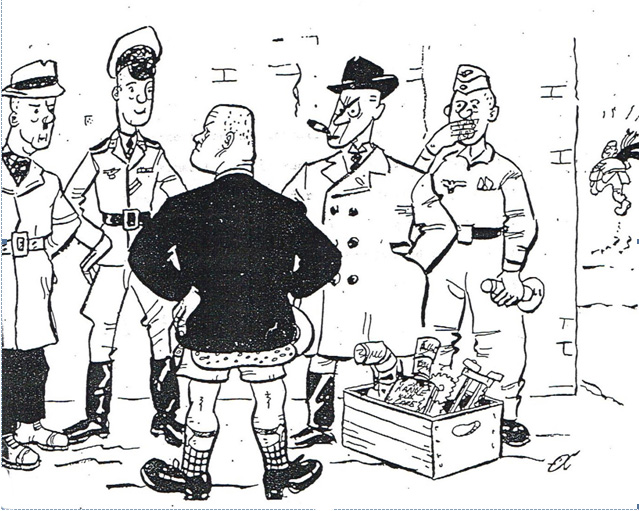
We’ve been searching Barrack B35- couldn’t find a thing.
Well what are you staring at???
Searches by the Gestapo, the dreaded secret police of Germany, took place from time to time. Prisoners, protected by the Geneva Convention and the International Red Cross did not treat these men with the respect accorded them by the Germans. Amongst the contraband articles in the sketch may be seen a copy of “Handle with Care”. This was inserted whilst the artist was in a bitter mood, owing to the fact that several of the original sketches from this book, which took three months to complete, were taken during one of these searches, with the consequence that they had to be repeated.
In the “Cooler” it was regulation bread and water, with a mug of watery soup, but every time I was served by our own prisoners I ended up with corned beef, spam, lumps of cheese, etc, all smuggled in, so one was never hungry. If you were a smoker, cigarettes and matches were also obtained.
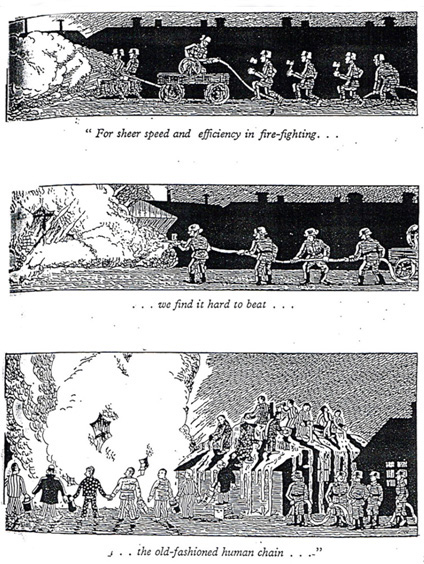
One night, after being locked in our room and most men in bed, we heard shouts of “fire”. Sliding back one of the wooden shutters which covered the windows (which were supposed to be bolted from the outside and which we could undo), we saw the camp theatre, a wooden building was well and truly on fire. Into the compound came several guards pulling the fire engine, a small wooden truck with a tank of water on top and handles each side which had to be operated up and down to pump the water out in a single jet. The jet was so weak and the heat so intense they could not get near enough to put water onto the fire and also the tank was soon emptied. Eventually men were allowed out of their rooms and a bucket chain was soon formed from the washhouse but we were losing the battle. At last the building collapsed, destroying a grand piano and many other instruments, (all provided by the Red Cross).
The day then came when we were told of the “D” Day Landings in Normandy. We had to hide our feelings and not give ourselves away. No doubt the Germans did not know themselves. Also, at the time, Russian forces were sweeping West so it was obvious we would soon be moving. Jerry would never let us be released.
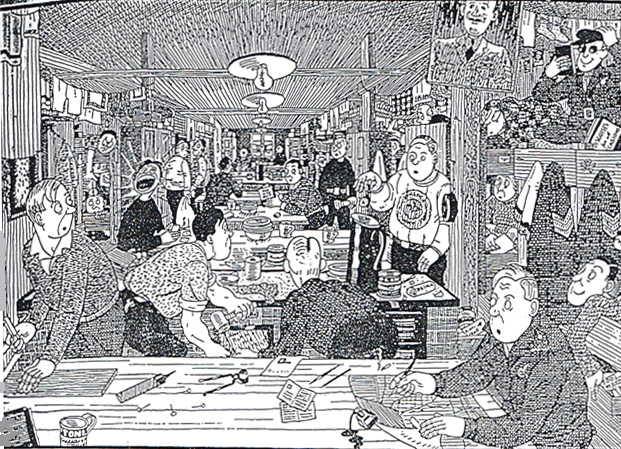
In all the RAF camps there were a number of Germans whose sole job was to look for contraband articles such as tools, maps, weapons, etc., also tunnels. These men were dressed in blue overalls and were referred to by the prisoners as Moles, Ferrets or Goons. It was the duty of any POW on seeing one enter a billet to give a warning of “Goons Up”.
“GOONS UP”
The theatre in Heydekrug, having provided many first-class performances, gave a grand finale when it was razed to the ground by fire. In an existence of soul-destroying monotony and boredom, this fire was one of the few exciting incidents, especially so, when the German equipment failed at the last moment and the fire-fighting had to be carried out by prisoners with buckets of water and sand.
CHAPTER SEVEN
SATURDAY 15TH JULY 1944
This was the day we finally marched out of Heydegrug. All the American prisoners had gone before us. With my few scanty possessions tied in a blanket we marched to the station and there boarded actual cattle trucks. These were divided into three sections by a barbed wire grille. The centre section was for four guards whilst thirty men were in each of the other sections. There was no room to lie down, only to sit with your knees up. The conditions were endured for two days and two nights until we eventually arrived at Thorn in Poland. (Now renamed Thoron). On leaving the cattle trucks one of our chaps translated some writing on the side which read “12 horses or 36 men”. This was a bright sunny day so Dixie gave the order we would march through Thorn in a proper military manner. This was to impress the polish inhabitants as well as German occupying troops. So off we marched in such a manner even the Grenadier Guards would have been impressed. As we marched through the streets the Poles were cheering and clapping. This angered the Commandant so much that he stopped the column and played “merry hell” into “Dixie”. He simply replied, “As military men that is the way we have always marched”. So off we went again as before. The German’s were not going to “muck us about”.
At last we arrived at Stamlager 357, a large camp with wooden huts, barbed wire and watch towers, occupied by a large number of British Army NCO’s. There is little to say of the short time were at Thorn but there is one incident which certainly embarrassed the RAF chaps. The army bods told us that on Sunday afternoons, women from Thorn sometimes walk along the road from Thorn to Posen. This road skirted the camp. If they were thrown a bar of soap or chocolate or even a tin of cocoa, they would reveal all. Sunday afternoon arrived. Just my luck I had no spare soap chocolate or cocoa, but with mates went down to the wire. Talk about laugh, there must have been about three hundred RAF blokes sitting there holding a bar of soap, chocolate or tins of cocoa, and not a woman in sight. The army blokes stood well back laughing their socks off.
CHAPTER EIGHT
FRIDAY 4TH AUGUST 1944
Again we were told we were on the move once again. With my belongings we marched back into Thorn and after a very long wait we were once more herded into the cattle trucks. Again 30 men to each end and 4 guards in the middle of the truck. The reason for the move was because the Russians were still advancing very swiftly westwards. It was obvious the Germans did not want us to be released and also they did not want to be captured. Again it was the same story, moving and stopping, and very many more German troop trains heading east with tanks guns etc. After four days and three nights in intolerable conditions we arrived at Fallingbostel on the 8th August. Fallingbostel is a small town to the south of Luneberg. This time the Germans did not intend us to march in a military manner. We had to run the four kilometres to the camp and many men were prodded with a bayonet to make them keep up. At last we arrived at Stamlager 355 (later renumbered 357). We were shattered. First we had to strip and be searched, then our clothes were taken for delousing. After standing naked for some time, (lucky it was August), we were allowed to take a shower, cold water of course. The camp itself was very large, divided into two compounds, one for army and one for the RAF. We could move freely between compounds. The buildings were constructed of brick, similar to Heydegrug. There were 80 men to each room with the usual stove and wooden tables and forms. I obtained a lower bunk. Above me was a Canadian, Earl Scott, “Scotty”. In early 1943, when as a wireless operator on “Wellingtons” flying from North Africa, he had been shot down over Greece whilst dropping arms and supplies to the partisans. He had evaded capture and finally joined up with the Partisans, fighting with them in the mountains for twelve months. He was eventually betrayed and captured by the Germans and was treated very badly. After a few weeks things took a turn for the worse. Due to attacks on the German rail network no Red Cross parcels arrived. The Germans were moving their essential supplies. There were rumours that some trucks were being looted by German civilians because they were also starving and so we had to survive on starvation rations which the Germans provided. These consisted of one seventh of a loaf of black bread, (this was the size of a normal house brick), two mugs of watery vegetable or millet soup (one at lunch time and one in the evening), three small boiled potatoes and on very rare occasions a small piece of “fish cheese”. This was similar to a fish cake. The worst part was getting it past your nose; it smelt horrible. Also issued to each man was a tin of dried mint tea. This was supposed to be boiled in water. It consisted of dried leaves. Some chaps used to roll it in paper and smoke it. It smelt like a garden bonfire.
Due to being on this starvation diet considerable problems were caused. Many of us broke out in boils which took a long time to heal. Our body resistance was very low. Some men lay in their bunks all day and were morose and depressed. Running along one side of the army camp was a camp for Russian prisoners. They were treated very badly. It was rumoured that when one died (and there were many), his body was cannibalised. The others had to do this to stay alive.
One day there was panic. It was found that typhoid had broken out in the Russian compound. “Dixie” Dean raised hell with the camp Commandant, and a few days later all the men were inoculated with serum from the Red Cross. Trouble was, with over 2000 men and very few hypodermic needles it was like being stabbed in the arm with a blunt knitting needle.
Eventually, some Red Cross parcels did arrive, not many. One parcel had to be shared by four men so it did not go very far. One thing was quite common. In the English parcels was a packet of tea. This was steamed open and the contents used in the normal way. Once used they would be dried, then placed back in the packet which was resealed. This was then exchanged with the German guards for bread. They never complained only when they were given a tin of cocoa and after opening it found under the top layer of cocoa was just soil.
On the 14th August I received a letter from home. It was from my Aunt Mabel and dated 4th June, her fifty-first birthday. This was a very pleasant surprise. A few weeks later I received a parcel of 200 cigarettes from an old friend, Harry Driscoll, with whom I used to work in”civvy” life before the war. I ought to explain that I did not smoke but cigarettes were used as currency in the camp. Several of he older prisoners used to run “swop shops” similar to the “tobacco barons” in Her Majesties prisons. The barons would set up a stall with numerous items of articles such as clothing, tinned food, soap, razor blades, etc. One could either buy these items outright with cigarettes or swop something else, adjusting the price with cigarettes. It was alleged that the barons had in their possession many thousands of cigarettes which enabled them to buy food from the German guards. Later, when on the forced march, not being able to carry all the cigarettes, they had to be given away.
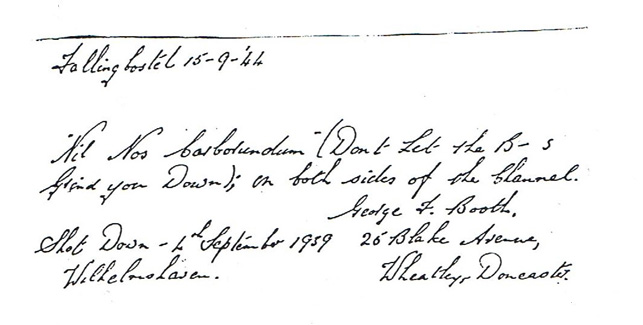
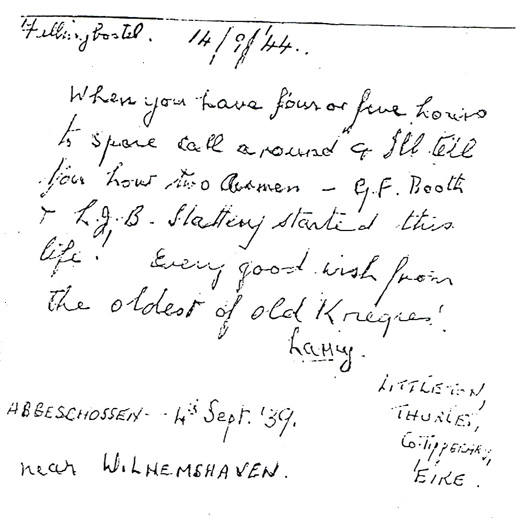
As a point of interest, regarding inmates in our room, I would like to mention three of the men. The first two were George F. Booth and Larry J. B. Slattery. George and Larry were the first two British airmen to be shot down on the first ever British raid of the war whilst flying “Blenheims” on the 4th September 1939 over the German Naval base of Wilhelmshaven. The third was Peter Pacey also of 102 Squadron. Peter had been shot down on the 9th September 1939 whilst flying a “Whitley” bomber.
His story is as follows: – Before the start of the war, British Intelligence had received a report that German scientists had developed a secret beam which could bring down aircraft; so on the night of 9th September a lone Whitley bomber took off and flew over Germany. It had no specified target, simply to fly around. Unfortunately the aircraft developed trouble and the crew were forced to bail out over Thuringen, where they were captured. It was not until later, when they sent a letter home, in code, it was learned there was no such beam, only engine failure had forced them down. I bet British Intelligence were greatly relieved.
One day whilst all the men were on “Appell”, extra guards heavily armed surrounded us. We could then see coming into the camp horses and carts loaded with Russian prisoners, also more guards. The Russians then commenced to go into each room and remove the paillasses, tables and forms and leaving each bed with just five boards. The camp Commandant then read out a statement saying that German prisoners in North Africa had been ill treated so as a reprisal our camp had been chosen to suffer. Not only that, but all drinking water was turned off and only came on for two short periods each day.
I guess in one way I was lucky. Weeks before I had been collecting the thick string that tied the Red Cross parcels so on going back to my room and finding the string intact I made a string hammock which I suspended on the wooden supports of my bunk. It took some time to get used to but it was far more comfortable than sleeping on five boards. I gave away my boards. Some of the guys put their boards into one bunk and slept together. They must have been very cramped.
During the day we could see the American 8th Air Force on its way to bomb targets deeper in Germany. Some bombers were shot down but we could also see numerous German fighters coming down after being attacked by the American fighters. During the night the RAF came over. All the lights in the rooms and on the boundary wire were switched off until the raid was over.
Close to Stammlager 357 was a large tank training school with several three storey brick buildings that looked like barracks. Many times during the day the tank men would pull up close to the boundary fence in the tiger tanks and sit taking the “Mickey” out of us, especially when playing football. One particular night, all the lights went out, indicating another air raid and then bombs began to fall very close. This went on for about 15 minutes. Next day we could see the tank school had been the target. It was absolutely flattened. We did not see any more tanks around the camp after that.
One important item in camp life was the “Blower”. This was a contraption built of wood and tin and used for boiling water etc. The principle was thus: – fitted to a wooden frame was a wooden wheel which when turned by a handle, turned into an enclosed fan by means of a string belt drive. The fan forced air along a tin tube into the bottom of the firebox, also made of tin. The fuel used was pieces of cardboard and wood and sometimes ashes gleaned from the dump outside the cookhouse. The fire was first lit in the bottom of the firebox and as fuel was added the wheel was turned. The air which was forced into the bottom of the firebox soon had the fuel burning and it was only minutes to boil a can of water, in fact several cans of water could be boiled for very little fuel. Some blowers were quite elaborate, using a series of gears. Very little effort had to be used to turn the wheel. If turned too fast it would blow the fuel out of the firebox. All the blowers in the camp, of which there were hundreds, were all made by the prisoners themselves with very primitive tools which were shared, such as a knife which had a blade to make it into a small saw. Scissors were used for cutting the empty food tins. Nails were made from barbed wire and so on.
Some men were very skilful. One in our room was a tinsmith in Civvie Street. With several empty tins he constructed a washing-up bowl, square shaped using nothing whatsoever to seal the joints, only a piece of thick wire to strengthen the outside edge. When filled with water not one joint leaked. Others were equally skilful in other fields. They would cut a raw potato in half, leaving to dry and harden, then with a razor blade and penknife they would copy a German stamp to such a fine degree it was impossible to tell the difference. These were used on forged documents to help would-be escapers.
Being all aircrew NCO’s we were not allowed to work outside the camp. This rule was once relaxed and four men from each room were allowed out, after signing a parole stating that we would not escape, to pick potatoes for a German farmer. Naturally they came back each day with their trouser legs and inside of their shirts full of “spuds”. These were shared with everyone else in the room.
Once again we were issued with a Red Cross parcel between four. Then we hit a bright idea. We would make a Christmas pudding to be eaten on Christmas Day. We grated several raw potatoes and placed them in a rag. All the moisture was squeezed out, leaving a kind of dough. To this we added several biscuits finely crushed, a packet of raisins, dried milk, sugar and a small amount of cocoa to give it colour. This was then tied into a piece of cloth and boiled for several hours. When cooked we hung it from a nail in the ceiling and there it stayed until Christmas Day.
CHAPTER NINE
TUESDAY 12TH DECEMBER 1944
Today is my 21st Birthday. I never let on to the rest of the chaps. I just kept it to myself. I did wonder how many more birthdays I would have to spend “behind the wire” but finally consoled myself because the news we were receiving showed the Allies and Russians were still advancing. Food was again very short. No Red Cross parcels. We were having to exist on the meagre rations the Germans issued. One incident that occurred at the time – but not in our room – was as follows: – in the afternoons, the room leader would collect the bread ration. He would then with a ruler, cut each loaf into seven equal portions, one seventh being given to each man. One certain man drew his own ration and also that of his friend who was out of the room at the time. He then lay down on his bunk and consumed both rations. When his friend returned he admitted to him what he had done. He was instantly taken in front of “Dixie” Dean who informed him that on his return to England the RAF would be notified of his crime and he would be court martialled. His punishment did not end there. He was frog marched to the latrines and taken inside where he was thrown into the pit. The pit was six feet deep and full of effluent. Fortunately this was the only incident of stealing rations that ever occurred.
Christmas Day eventually arrived and although it was very cold there was a Church Service on the parade ground. Practically every man attended. Then it was back to the room and the Christmas pudding was taken down and put on to boil again. Lunchtime the Germans excelled themselves. This time we had a cupful of pea soup, everybody tried to find a pea but no luck. Then there was the pudding, which was cut into four portions. I must admit, as hungry as I was, it took some getting down but not a crumb was left. It is something I will never forget. For two or three days I could feel a weight, not on my mind but in my stomach.
Christmas and the New Year passed. We were now in 1945. It would soon be 12 months since I was shot down. We had not received Red Cross parcels for some time. We were still surviving on German rations. Some men were very depressed. One prisoner one afternoon walked up to the warning wire about knee high. (No one was allowed to step over this wire and warning notices indicated that in doing so you would be shot). The prisoner in question stood talking to the guard in the watchtower. Suddenly he stepped over the wire, walked to the outer fence and began to climb the barbed wire. Without hesitation the guard aimed his rifle and shot the prisoner dead. They never went in for wounding.
There was also another shortage in the camp – firewood. Very little was issued for burning on the stove which heated the room and also for any cooking when one had food i.e. potatoes. It was finally agreed with the camp Commandant that four men from each room would be allowed each day under armed guard and the usual signing of the parole form not to escape to collect wood from the nearby forest. We were issued with axes and saws to help us in this task. The day came, in company with “Scotty” and two others I went out to collect firewood. That was the day we landed ourselves in trouble.
We arrived at the forest and began to cut down pine trees with the saws, finally trimming off the branches with the axes. It was then that “Scotty” noticed the telegraph poles carrying several wires. With guards being some distance away we cut down a tree which, when it fell, crashed onto the wires bringing them down. Unfortunately we were spotted by one of the guards. All four of us were marched back to the camp and locked in the “cooler”. Later we were marched in front of the Commandant. “Dixie” was present. It was then we were informed that having committed an act of sabotage against the Third Reich we would be taken to Hanover and there face a military court, where we would be charged and sentenced, with the possibility of being shot. In company with “Dixie” we were allowed back in camp. He complimented us on what we had done and told us not to worry. I must admit it had me worried at the time. Fortunately our act did not stop other parties going out to collect firewood, but it kept “Jerry” on his toes.
CHAPTER TEN
6TH APRIL 1945
THE FORCED MARCH – THIS IS WHERE I STARTED TO KEEP MY DIARY AGAIN
During the morning “Appell”, Dixie informed us that we would be leaving Fallingbostel today, destination unknown. There would be no transport so we would have to march. Each man was issued with one loaf of bread and two blocks of “Ersatz” margarine. So tying up my few belongings in my blanket I sat around and waited. Columns of men, about 30 in each, were moving off at certain intervals. At about 6pm my column moved off and out of the camp we marched with a large number of guards. Marching at the side of us was one guard carrying a heavy pack and rifle. He could not have been much older than fifteen years of age. After covering about 7 or 8 kilometres this young guard began to limp quite badly. On we went and then it was noticed he was crying with pain. I offered to help him carry his pack, but typical of the “Hitler Youth” he swore at me and refused my help. Shortly afterwards he fell to the ground and we carried on.
Although darkness had fallen it was a full moon. About 10pm we heard the distinctive engines of a “Mosquito” aircraft and then it flew over us very low. Suddenly it turned back, with all guns firing. I flung myself to the ground. Next instant there was a loud explosion. The “Mosquito” being so low, had hit the top of some trees and finally crashed and exploded in a field. I felt very sorry for the crew. It was at this point that war came back to me in all its reality. Some of our chaps were wounded but none fatally.
After marching about 22 kilometres we arrived at a farm and here we spent the rest of the night in a large barn.
7TH APRIL 1945
Today we were told it would be a day of rest so we started to forage around. Under a straw stack I found six eggs but later discovered they were all “hard set”. A potato clamp was raided, much to the annoyance of the farmer. I also found some pig meal which we made into porridge. It was awful. Later we were issued with a cup of very watery pea and potato soup. There was great activity overhead by the American 8th Air Force and we saw four men bale out of a burning “Fortress”.
8th APRIL 1945
We started to march again. After covering 10 kilometres we stopped in a wood where we were we would be staying the night. We were issued with “Spuds”. I then made a bed of bracken and fir branches. When I awoke in the morning I found “Scotty” had gone. Whether he made it or not, I do not know. I never saw him again.
9TH APRIL 1945
We marched 16 kilometres today. It was very hot and I began to suffer with dysentery. We were issued with one tin of meat between four men and looking back it resembled today’s tin of dog food, also more “Spuds”. There was also plenty of activity by the German Army with numerous columns of troops passing us. There was also a lot of low flying “Spitfires”.
10TH APRIL 1945
Another day of rest in an open field. I had my first good wash for days in a stream. There were lot of “Spitfires” flying about. I finished the last of my bread. Bombs dropped at night, they seemed very close.
11TH APRIL 1945
Marched 12 kilometres today. Even the Germans did not know where we were going. Passed through the town of “Soltau” The people seemed to pity us and they gave us water. Another issue of “Spuds”. We finally stopped in a pine copse where we spent the night.
12TH APRIL 1945
Marched 14 kilometres today and we received a good issue of “Spuds” for a change, but nothing else.
13TH APRIL 1945
Another day of rest. I had a wash and shave, felt much better. The Germans killed a cow today so we received a small piece of meat with our “Spud” issue.
14TH APRIL 1945
Marched 14 kilometres and eventually stayed at a farm. As usual, we started to forage. We found some potatoes which I later roasted. Also found a hen house and I could see inside about two dozen eggs but I was too big to get through the trap door so I missed out. I also stole a loaf of bread from a German guard. It happened as follows: – as we were sleeping outside the Germans allowed us to go into the barn to get an armful of straw to lie on. The guards were allowed to do the same. Coming out of the barn with my armful of straw I noticed one of the guards had laid his knapsack on the ground. On top of this he had placed a loaf of bread. Most unfortunately I stumbled and fell over, dropping my straw. When I picked myself up and the straw, the loaf of bread was inside it. This I later shared with my mates.
15TH APRIL 1945
Marched 25 Kilometres today, passing through Luneburg. The civilians informed us they had no bread or food they could exchange with us. (I still had one bar of soap left). We also passed alongside a “Luftwaffe” base. Here we saw the demolition that was going on. The grass runways were being ploughed up and numerous aircraft, JU88 night fighters, Focke Wulf 190 fighters and many other types were being blown up around the field. The guards informed us they had no fuel to get off the ground.
16TH APRIL 1945
Marched 14 Kilometres today. I traded my last bar of soap with a Polish worker for two slices of black bread and a slice of fat pork.
17TH APRIL 1945
Marched 12 Kilometres and during darkness we crossed the river Elbe at Lauenberg. The river here is very wide and was spanned by a very big girder bridge. We carried on marching most of the night and eventually stopped on the bank of the river. During the day, I and most of the others had a good bath in the river. It was whilst doing this a paddle steamer loaded with German troops passed by us. Suddenly without warning, a flight of “Tempest” fighters appeared and began to attack the paddle boat with cannon fire. I didn’t stop to look. Naked as I was, I belted across the field and then sheltered behind a tree with about three others, including a German guard. When the firing stopped and the planes had disappeared, we went back. What a sight. The paddle steamer was on fire and sinking fast. There seemed to be hundreds of bodies in the river, many without arms or legs, some wearing heavy knapsacks were sinking and drowning due to the weight. We managed to rescue quite a number but we could see by their wounds they would not last very long. We were then marched further along the bank.
18TH APRIL 1945
Another day of rest. Issued with a small piece of fresh meat and “Spuds”. Still great air activity by our fighter aircraft. There was a heavy thunderstorm that night and sleeping in the open we were drenched though. I should also mention that during the day we saw several bodies floating down the river from the previous day’s attack.
19TH APRIL 1945
Marched 17 Kilometres today and when near the town of Cresse we came to a column of Red Cross Lorries where each man was given an American food parcel. We also passed another column of our chaps, who were sitting down and eating. No sooner had we passed this column when they were attacked by eight “Typhoon” fighters diving one at a time. The last plane in must have realised his mistake because he waggled his wings and flew on. As a result of this raid 60 men were killed and over a 100 injured. The dead were later buried in a communal grave, the service being conducted by Padre Morton, our camp padre, and a German Pastor. Further along the road we were again issued with a Canadian Red Cross parcel. Even that did not raise our very low spirits. We finally stopped at another farm house and straight away we laid our towels, such as they were, on the ground to form the letters POW. Several times our fighters flew over, waggled their wings, a sign they knew who we were.
20TH APRIL 1945
Another day of rest declared. By bartering with the farmer I was able to obtain 6 eggs and a small loaf in exchange for a tin of cocoa and a bar of chocolate. I then had my first good meal for a very long time. Trouble was, my stomach was not used to such rich food and it was not very long before I was violently sick. This kept on during the day. We were also allowed to sleep in a very large shed. This was our first night under cover for some time. It also poured with rain all night.
21ST APRIL 1945
We marched 18 Kilometres today in pouring rain. My clothes were wet through and my boots were full of holes with hardly any soles left so my feet were also wet. I felt very weak and ill but I had to keep going. Finally, we stopped at another farm where we were billeted in a barn. Again we were issued with potatoes but I felt too ill to eat.
22ND APRIL 1945
Today we marched 18 Kilometres in a slight drizzle. It seemed we were getting closer to the fighting area. On the sides of the road were numerous vehicles burnt out or blown to pieces. There were also numerous horses and carts with dead horses, very bloated or blown up. We also noticed any German vehicle that passed us, almost all of them military, had two men each sitting on the front wings, one facing to the front the other to the rear. This was to enable them to see our fighters before they could attack them. It was obvious whatever moved on the roads it was likely they would be attacked. We even saw a fire engine blown up on its side. That night we again slept in a large barn and also had a good issue of “Spuds”. By now I could eat a little better but I was now again suffering from dysentery.
23RD APRIL 1945
Another day of rest. The weather was fine so most of the day I spent lying outside. I still felt very weak being troubled with dysentery.
24TH APRIL 1945
We moved off again. Today marched about 12 Kilometres and came to the small town of Harmsdorf. Here we were billeted on a very large state farm. We were sheltered in a very big barn containing plenty of straw. It was very comfortable. Issued with the usual “Spud” ration.
25TH APRIL 1945
No moving again today. Very little to do. Just spent the day lounging around.
26TH APRIL 1945
Again there was no moving. We could also hear the sound of heavy gunfire. At times it seemed very close.
27TH APRIL 1945
Once more we were told we were not moving. Most of the time was spent just wandering around the farm. The gunfire was again heavy. It seemed even closer.
28TH APRIL 1945
Today was a very important day. Once more we were told we were not moving. My pal by then was a Welshman named Norman Powell who came from Pontllanfraith, South Wales. Norman had been shot down over the Skaggerat on the 28th August 1941. He could also speak German quite well. Whilst wandering around the farm we came across a group of Russian farm workers. Norman was trying to converse with them when two other Russians came running up very excited. We could not understand what they were saying. After a time the leader spoke to Norman in German. Norman turned to me and said with a big smile on his face, “Knobby, the British Army is just down the road”. We hugged each other, even some of the Russians. We immediately went to the Deputy Camp Leader, (“Dixie” was not with us at this time), and told him what we had heard. He suggested that with two others Norman and I should make our way to the road. This we did. It was easy to slip past the guards. We travelled along this minor road for just over a mile when we came to a major road. We sat there for about ten minutes. There were plenty of German civilians trudging past us, heading West. They paid us no attention. Then, to our delight, along the road came a column of British armoured cars. I was still wearing my RAF uniform so stepped into the road and held up my arm. The leading car stopped and an army Major got out. We explained to him we were prisoners of war and that there were also 300 more at the farm. His reply was “Sorry lads, I’ve got to get to Lubeck, go back and tell the German guards to give themselves up”. With that he gave us some tins of corned beef and a large tin of army biscuits and off they went. We returned to the farm and showed the Deputy Leader the corned beef and biscuits and told him what the Major had said. Taking us and the tins to the German officer in charge of us and explained what had happened. The German officer then called all the guards together and spoke to them. Without any fuss or bother they laid down their rifles. The officer handed over his revolver and said “We are now your prisoners”. I think they were very glad. Still under orders from the Deputy Leader we were told not to leave the farm, so once again we spent a comfortable night in the barn.
CHAPTER ELEVEN
29TH APRIL 1945
About mid morning our Deputy Leader, Norman and I went back to the main road. Some British lorries passed us and out came more corned beef and biscuits. Eventually we stopped a jeep containing four military policemen. One was an officer. He told us that all prisoners of war were to make their way to Luneberg where a big reception depot had been set up on some army barracks. We were also told we could commandeer any German vehicle to enable us to get there. Regarding our German prisoners, they would have to make their way to Luneberg on foot. We returned to the farm and informed the rest of the column what they had to do. Once more we went back to the main road. There were plenty of army lorries heading West, obviously to get away from the Russians. Many of these lorries were stopped and the Germans kicked out, (by this time we all carried arms, either rifles or revolvers). Some lorries carried wounded troops. These were allowed to carry on.
One very amusing incident happened that day. Whilst we talking to some military policemen, two RAF chaps, both cockneys, sat at the side of the road when up drove a big black Mercedes coupe with an army driver. Sitting in the back was a German General and a woman, either his wife or mistress. I believe the latter, she was much younger. One of the cockney lads who had armed himself with a sub machine gun stepped into the road and stopped the Mercedes. He then walked over to the military policemen and said “Is it true we can commandeer any German transport?” “Yes” was the reply. He then said “watch this”. With that he went back and stuck the barrel of his machine gun into the General’s stomach and told him in German” rouse, rouse” which translated means “out, out”. The General looked towards the policemen for assistance, but seeing he was not getting any help he got out with his woman and stood at the side of the road. Strapped to the back of the Mercedes were three large suitcases. Some Russian women, on seeing what had happened, instantly got hold of the cases, tipping their contents onto the road. Next we saw several Russian women dancing in the road all wearing expensive dresses and evening gowns. Meanwhile our cockney lads were seated in the back of the Mercedes and still with the German driver drove off heading towards Luneberg. The German General meanwhile tried to stop several vehicles in order to get a ride but all the vehicles drove on. It showed the contempt the privates had for the generals. He was last seen walking along the road with his woman tagging along behind. (He was later picked up by the military police).
Norman, myself and two others, Len Stokes and Clifford Price, then stopped a vehicle. This was a 50 cwt truck and was a mobile radio van. We forced out about eight Germans and took it over ourselves. Norman then drove it back to the farm. Inside the truck we found it contained seats and tables. On the tables was stacked all the radio equipment. On the roof were the dismantled radio masts. These we dumped. Meanwhile Clifford had found some whitewash on the roof. He painted the Allied insignia, a star inside a circle, and on the sides POW. We did not want to get attacked by our own planes. The vehicle contained plenty of fuel and some spare cans. We also decided to spend the night at the farm and move off next morning.
30TH APRIL 1945
We set off and drove back to the main road heading for Luneberg. The road was packed with civilian refugees all heading West. This made progress very slow. After travelling about 10 Kilometres we came to a small village where we were stopped by a platoon of our troops led by a young Captain. He enquired if any of us could speak German. Norman said he could so the Captain said” Come with me”. He then took us to a barn and inside we saw about 20 soldiers of the Hitler Youth, mere boys. The youngest was about 12 years, the oldest about14 years. The Captain said he wanted to interrogate them and asked Norman to act as interpreter. This he agreed to do. One at a time they were brought out to face the Captain who sat at a table with Norman. Placed on the muddy floor in front of the table was a German Swastika flag. Each youth was made to stand on the flag and wipe his feet but as young as they were, they were defiant and would not stand on the flag, but with numerous kicks and belts around their ears from the soldiers they finally gave in. Little information was gained from these boys. It would appear they had been moving ammunition in small hand carts to supply their troops until they were left behind. The Captain thanked Norman for his help and to show his appreciation he gave us half a pig freshly killed, a small sack of carrots and potatoes and three bottles of Schnapps. These were loaded on board, the pig on the roof and off we drove. Again, progress was slow until we eventually arrived at the town of Bolzenburg, where we decided to spend the night. Meeting up with some military policemen we explained our situation and stated we wanted somewhere to stay the night. First they took us to an army cookhouse where we were supplied with tins of spam, tinned mixed vegetables and tins of peaches. Still with our van the pig on top we were taken to a block of flats. Here we were shown an apartment, very smart and well furnished, and told we could spend the night there. A little later there was a knock on the door, and when we opened it there stood an old man and his wife. He explained to Norman that he was the caretaker. It was finally agreed that the woman would cook us a meal with the pig and vegetables, while the man would light the boiler so we could have a bath before the meal. After our bath we were called into the dining room of the flat. What a sight! On a very large polished table top were two candelabras, all alight, crystal wine glasses and a wonderful dinner service. Once seated the food was brought in, roast pork, pork chops, potatoes, carrots, mixed vegetables and afterwards peaches and tinned milk. I had one glass of Schnapps. That was enough for me. Then to bed in a real bed with sheets. It was too good to be true.
1ST MAY 1945
None of us were awake until about midday. After a good wash, (I could not shave as I had no razor blades), we went back into the dining room and once again a meal was laid out, spam and vegetables. We eventually decided we would spend the day in Bolzenburg and push on the next day. During the afternoon, talking to some of our soldiers they said “Would you like a drink?” Of course we agreed. They took us to a brewery and inside we saw several large casks all full of wine, so finding some glasses we got “Stuck In”. Meanwhile, another crowd of our chaps arrived who had been in the same column, so we had a right booze-up. When we left later that afternoon we were all utterly blotto. We returned to the flat where later on we were again served roast pork etc. I was enjoying this life and so once more to bed.
2ND MAY 1945
Today we were moving on. We gave the rest of the pig and vegetables to the caretaker and his wife. He then requested that we write a letter stating how he had helped us during our stay there and to sign our names. This he could show the authorities hoping to get preferential treatment, so Norman wrote the letter and we all signed our names, which if I remember rightly, were as follows:- “Mickey Mouse”, “Clark Gable”, “Tommy Handley” and “Boris Karloff”. The caretaker was overwhelmed, we shook hands and drove off. The next place we came to was Lauenberg, by the side of the river Elbe. Again the army found us some billets, this time in a small hotel. There was no staff there so we dined in the army mess that evening and slept in the hotel.
3RD MAY 1945
Moving once again we came to the river Elbe. The bank on our side was filled with refugees. I then saw the big girder bridge we had crossed over some previous days had been blown up by the retreating German army. The centre span was lying in the river. We saw the army had built a pontoon bridge. The river here was about 150 yards wide, very deep with a swift current. The pontoon bridge consisted of small canvas boats anchored to the river about 12 feet apart. On top of the boats was laid a wooden roadway about 8 feet wide. There were notices attached to the bridge stating “all vehicles must stay 20 yards apart”. I could see army trucks going over the bridge. They were swaying and going up and down as the boats went down under the weight. After speaking to an army officer we were told we could cross over. Some of the refugees pleaded with us to take them over but we were not allowed. Norman drove onto the bridge. I must admit I did not fancy this crossing so instead of riding inside I stood on the running board of our vehicle. So over we crossed very slowly, up and down we went, swaying so much I thought we were going to tip over. After what seemed like hours we arrived on the other side and drove up the bank where we stopped. Going back to the river’s edge we noticed two army amphibious boats, each with a crew of four wearing life jackets. I said to one crew member “I did not enjoy that”. He laughed and said “You should have been here yesterday, the bridge broke loose and we lost three lorries, we only repaired this morning”. I think I said a silent prayer.
We carried on driving. Due to lack of refugees we were able to make good progress. Several times we had to drive off the road into a field and then back onto the road. This was because certain areas were blocked off with white tape. These had signs indicating the area was mined. Late afternoon we drove into Luneburg and there we were directed to a very large army barracks now used by the British. We drove our vehicle to a parking area and left it with several hundred other German vehicles, all obviously used by returning prisoners. Next we had to report to a building which had a sign reading “Reception and Documentation”. We entered a large room with doors at each end. Standing at each door were two military policemen with others standing in the room. In the centre of the room were two tables. Sitting at each table was an army Major. The badge on his arm indicated that he was attached to the “Intelligence Corps”. I was then handed a form and told to fill it in with details of my name rank and number, unit or squadron, when captured and which prisoner of war camps I had been in. After filling in the form I joined the queue to present the form to the Major. I then noticed that once he read the form he referred to a black covered book on the table. One army sergeant presented his form, the black book was opened and after closing it the Major looked towards the group of military policemen, nodded, whereupon two policemen stepped forward, took the sergeant by his arms and escorted him out of the doors at the end of the room. Not a word was spoken. It was obvious to me they were looking for prisoners who had collaborated with the Germans. Then came my turn. The form was read, book opened, perused, then closed and I was told to leave.
In another room we were allocated a room number where we would sleep. We were also told that after about two days we would be flown back to England. Also, we were not allowed to leave the barracks. Going to our allotted room we found about 40 other RAF men there, mostly from our previous camp. The room consisted of two tier wooden bunks same straw paillasses, two blankets and the usual wooden tables and forms. It was like being back in the prison camp. After a meal in a large mess hall we watched a film and then retired to bed.
CHAPTER TWELVE
4TH MAY 1945
There is little to report for this day. I went to the barber’s shop, run by German civilians and had a good haircut. Payment was made by giving five cigarettes of which I had plenty, having received a tin of fifty on my arrival. The rest of the day was spent just lying around. There was nothing else to do.
5TH MAY 1945
Today I managed to get a razor and shaving brush from the Red Cross. It was a treat to get rid of the bristles on my face. There was still nothing to do. No sign of moving out. I watched another film show in the evening.
6TH MAY 1945
Still waiting. No sign of moving out although numerous lorries were leaving all filled with army ex-prisoners. Spent the day just lying about.
7TH MAY 1945
Today we decided to stir things up. This was our fourth day here and still no sign of moving. Again many lorries were leaving and as usual were packed with army chaps, so we went to the Reception Office, demanding to see the officer in charge. After waiting some time he eventually presented himself. We explained that it was our fourth day in the barracks and wanted to know when we would be leaving. We told him that army men were coming in and leaving the next day. He stated as we were RAF and not many of us we would have to wait until there were enough of us to move out in one convoy. This seemed most unfair. We could be there for days. We then held a meeting and it was decided to visit every room in the barracks and find out how many RAF men there were there. This we did and the final total was just over 200. So back we went to the officer at Reception. When given the facts he replied “There must be at least 500”. It seemed obvious they were not bothered about the RAF.
8TH MAY 1945
This was to be our lucky day. We decided we would go to the main gate and there do a count of any RAF men arriving, so a group of us lay on the grass just inside the gate. It was a warm sunny day and we had nothing else to do.
About midday who should come through the gate but an RAF Group Captain. Seeing us RAF chaps he came over to us. We gave him the whole story of having been there five days and no chance of leaving. He instructed us to get all the RAF men together and then wait for him at the gate. He disappeared into Reception. After about fifteen minutes, during which time we had gathered all our chaps, the Group Captain reappeared and told us the next convoy of lorries would be ours and that he was staying with us until we reached the aerodrome at Luneberg where we would then fly home. The lorries arrived and we piled aboard and after a short journey we arrived at the airfield. Here we could still see the planes which had been blown up but the grass runways had been rolled flat and strengthened with steel mesh. We were then divided into groups of 30 men. I was in the first group; we sat on the grass waiting for the planes to arrive. After about two hours down came seven “Dakota” transport planes. They taxied back to us at the end of the runway, where stores were unloaded and the aircraft refuelled. The Group Captain who was still with us, then shook us by the hand and we expressed our thanks for his help. We climbed on board and it was not very long before we were airborne. It was great to be flying once more. We flew over Germany and into Holland. The navigator came back to us and pointing out of the window said “Arnhem”. Looking down we could see hundreds of “Horsa” gliders, all where they had landed, and some broken up. There were also crashed “Dakotas”. There were hundreds of shell craters and the town itself was flattened. The bridge was still standing. Eventually we flew over the British coast and then down to land at the RAF Station at Dunsfold in Surrey, and what a reception we had.
Here I should describe my appearance. My uniform, battledress blouse and trousers were very worn. There were holes in my knees and the seat of my trousers, also in my elbows. My boots were tied with string and one sole was flapping. I was still wearing my flying sweater but this was full of holes and was not white any longer, but I was still wearing my Sergeant’s stripes and my engineer’s brevet.
The aircraft came to a stop near a very large tent which was pitched about 100 yards from one of the large hangars. I was first out of the plane and was greeted by some RAF Medics, who said “Come this way gentleman”. I was taken into the tent by two Medics, who commenced to spray me with DDT powder, one at the front and one at the rear, up my trouser legs, down the front and rear of my trousers, up the front and back of my shirt and then up each arm. I was well and truly covered. I was then directed out of the tent through another opening. It was then I saw two lines of people stretching to the hangar to where I had to walk. There were Air Marshals, Air Commodores, Group Captains, and all other officers, WAAF officers, Red Cross nurses, WAAFS and ordinary airmen. Here I was shaken by the hand, slapped on the back, kissed by WAAFS and nurses and told “Welcome Home”. I had my hand shaken by everyone. Then with a WAAF on each arm I was led into the hangar. I was told we were the first aircrew to be repatriated. When I stepped inside the hangar I could not believe my eyes. There were arm chairs, settees and even carpets on the floor and at one end dining tables and chairs. Still with the WAAFS on each arm I was led to a settee and told to sit down. The only time they did not hold my hand was when I was given a cup of tea, by a very pretty Red Cross nurse, (the WAAFS were not bad either). When all our chaps were seated we were then addressed by an Air Marshal. He welcomed us home, saying how brave we had been and all the suffering we had endured. He also spoke of the comrades who never made it. I noticed one of the WAAF’s sitting next to me had tears rolling down her face and she was gripping my hand even tighter. I was very nearly crying myself.
Next we were led to the dining area, still with the WAAFS hanging on and then seated between them. After partaking of a hot meal, we were returned to the settees. The Air Marshals and all the high ranking officers were now moving amongst us chatting away. At about 8pm that evening we were told we would be travelling to RAF Cosford in Staffordshire during he night, arriving there early next morning, so eventually after a lot more hand shaking and kissing and a very emotional parting from my two WAAFS, we boarded coaches and were driven to Dunsfold station where a train was waiting. By this time the news had reached Dunsfold of the returning aircrew. There were hundreds of people there. After a lot more hand shaking, hugging and kissing we boarded the train. The people did not just stand there; they also got on the train. They had crates and bottles of beer which they were dishing out to us and drinking our health. They really celebrated our return. About one hour later, having cleared the train of the kind people of Dunsfold we pulled out with two men to a compartment so we could lie full length and try to get some sleep. This was virtually impossible. Also on the train were several Red Cross nurses who moved up and down asking if we wanted anything, i.e. sleeping tablets. Most of the journey was spent chatting to them and drinking the beer we had been given.
9TH MAY 1945
We arrived at Cosford at about 8am where we had to board coaches to be driven to the RAF Station. This was only 200 yards. We were taken into the dining hall for a hot breakfast and from there into one of the hangars where we filled in a telegram form telling our parents the good news that we had arrived back in England and would soon be home. Next we were taken to our sleeping quarters. On each bed was a pair of pyjamas. We were then instructed to take a bath or shower and our old uniforms thrown outside to be burnt. After showering we put on our pyjamas. What a sight!! A lot of swopping around had to be done in order to get something that fitted. Then we were told to go to sleep until lunchtime but all we did was lie on the grass outside in the warm sun, whistling at the passing WAAF’s. Lunchtime over, we went back to the hangar. Here we were given a very thorough medical examination. I told the doctor I had suffered with frostbite and he examined my feet more carefully, stating that the camp doctor had done a very good job. Next we were moved on to be interrogated by Intelligence Officers. The one who interviewed me actually came from my old squadron and I knew him personally, having been debriefed by him on several occasions upon returning from bombing raids. He expressed some concern when he knew my pilot had bailed out and left me. He was also impressed when I told him I had tried to evade capture, especially with regard to the weather conditions at the time.
Pay Accounts was my next port of call. It was here I was told I had been promoted to the rank of Flight Sergeant, so now I could wear a crown above my stripes. I also received quite a large amount of money – fifteen months back pay, for the time I had been a prisoner. I also received ration and sweet coupons ready for the two months leave I would be getting: also my travel warrant home. Then to stores, where we were measured and fitted with new uniforms etc, wings and stripes were sown on by the many civilian tailors working there.
10TH MAY 1945
Today is the day we are going home, boarding the coach and back to the station, first stop Birmingham. Here I say goodbye to Norman, Len and Clifford. It was a sad parting, after what we had been through. Then on to Leicester and finally my hometown. Coming out of the little station there was my Aunt Mabel and Uncle Arthur. They lived just across the road. They had been watching every train in since the telegram I had sent had arrived home. After a lot of tears, hugging and kissing, Uncle Arthur was sent on ahead and made to carry my kitbag and to warn my parents I was coming. Then with Aunt Mabel hanging on my arm I made my way through town. Again, hand shaking and hugs from all the people I knew and some I did not know. At last we turned the corner into my street. I was overwhelmed. There was bunting and flags and all my relations standing there waiting for me. I felt like turning round and running away, but Aunt Mabel hung onto me.
There was one very solemn moment amidst all the jubilation. That was when a neighbour, Mr Crank, came to me and shook my hand. With tears in his eyes he said “Welcome Home”. His eldest son, Arthur, with whom I went to school, had been shot down whilst flying as a rear gunner in a Lancaster bomber. He was never heard of again.
And so I came home.
Looking back over the past 15 months, I reflected on the very bad times, the very hard times, the few very good times and also the wonderful “esprit de corps” that had existed amongst my many colleagues, the aircrew of the Royal Air force, and so here I was, a little older but much, much wiser.
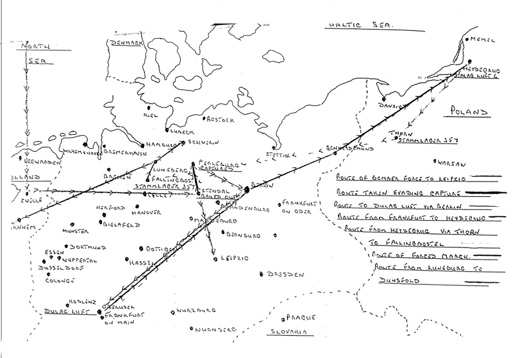
EPILOGUE
After two months leave I was posted to an RAF Prisoner Rehabilitation Centre at RAF station, West Malling, Kent. For the month I was there, time was spent visiting places of interest, i.e. Chatham Royal Navy dockyard, Shape’s Toffee works at Rochester and many other places. I also attended many receptions given by Mayors and Aldermen of different places, Dover, Margate, Folkestone and many more. After the month was up, I was given another six weeks leave.
Then in September I was again posted to the RAF School of Technical Training at Melksham in Wiltshire for an updated course on Aero engines and propellers. It was at Melksham I was again promoted to the rank of Warrant Officer.
In early January 1946, after successfully completing my course at Melksham, I was again posted to 46 Maintenance Unit at RAF station Lossiemouth, in Scotland. At Lossiemouth there was stored over 1000 aircraft comprising mainly Lancaster bombers, Beufighters and Harvard trainers. Many of these aircraft were being refurbished and then handed over to France, Holland, Belgium, Denmark and Norway, who were now rebuilding their Air Forces. Also there were the remaining Lancasters used on the famous “Dam Busting” raid, including Guy Gibson’s aircraft. These were eventually broken up.
Coming into the station were new “Lincoln” bombers. These were fitted with four blade propellers, more powerful engines and cannons in the turrets, replacing the old 303 machine guns. Once tested they went out to he squadrons to replace the Lancasters. My job at Lossiemouth was to flight test all these aircraft, my pilot being Flt/Lt Bill Warwick. It was a very interesting job. We had some scaring moments when some of the older aircraft developed faults, but nevertheless, I was glad to back on flying.
On passing I would like to mention another point of interest, when testing the Lincoln bombers we carried an air gunner, Warrant Officer Ronald “Curly” Emney. His job was to test the newly fitted cannons over the firing range on the Moray Firth, not far from the famous school at Gourdonston.
I remained at Lossiemouth until November 1946 when I was finally demobbed, so ending my career in the Royal Air Force.
Again, reflecting on my experiences of what I have seen and done and what I had been through, I would not have missed it for one moment. I am truly proud to have served and flown in the Royal Air Force.
In conclusion I would like to quote two poems, both written whilst in a prison camp. I think they signify my feelings and also that of many other aircrew.
OPERATIONS
We flew as graceful as a bird
That soars on high through cloud and skies
When all at once we saw a herd
A bunch of red and green T.I.’s
(Target indicators)
It may have been our final hour
Yet not a tremor did we feel
Nor did one spark of fear devour
Our great unconquerable zeal
The target lay below us now
Gigantic fires slowly grew
And from the lap of heavenly kings
Cascaded flares of every hue
Just like a farmer then we knew
That we still had our seeds to sow
Then bomb doors gaped like giant’s mem
And spewed its load of death below
That awful splendour made us dazed
As if in some mysterious spell
And held us there as if we gazed
Into the fiery depths of hell
And so with senses full regained
The scene below us dwindled low
And faded until it just remained
A lurid incandescent glow
The engines sang a mighty roar
And bore us high o’er sea and plain
Our hearts were beating full and strong
As we came safely home again
AIR BURIAL
Say not O Earth, they are too many and too loud
Who fling their lives like rockets in the sky
The young, the beautiful, the proud
O Earth receive them when they die
Say to them “Children it is late”
Press from their eyes the hate.
These were the fairest blooms upon the tree
Plucked by the thunder and the careless hail
Now they are quiet and forever free
Nor can we follow where they sail
Between the star wane and that clouded dawn
Their compassed hearts were set upon
Mother bestow them ‘neath your ancient cover
Safe from the thrust of fear and pain
Lap them in darkness, say to friend and lover
These were brave seeds and they shall bloom again.