
A resident of Woodnewton who was sentenced to be transported, twice
William Mould was born in Woodnewton and was baptised on 31st May 1812 in St Mary’s Church1. His parents were Henry and Mary Mould (née Simmons) who lived in the village, but the precise location of their house in unknown. Henry was a sawyer – a carpenter who sawed timber into planks. William was the eldest of his parents 11 children and became a sawyer, like his father. William married Eleanor (aka Ellen) Todd of Yarwell in 18332 and they too lived in Woodnewton. Records of baptisms at St Mary’s Church show that they had four children by 18413.
William Mould is not recorded in the 1841 Census returns for Woodnewton. Ellen on the other hand is listed as 25 years old and living with three of her children; Eliza 6, Charles 4, and Mary, together with two lodgers. Her eldest son Henry, aged 8, is recorded as living with his grandparents.
Ellen Mould is subsequently recorded as living in Woodnewton in both the 1851 and 1861 Censuses, but again there are no details of her husband William. In the 18514 Census she was 39 years of age and the wife of the head of the household. She is described as a Carpenter’s Wife and Pauper.
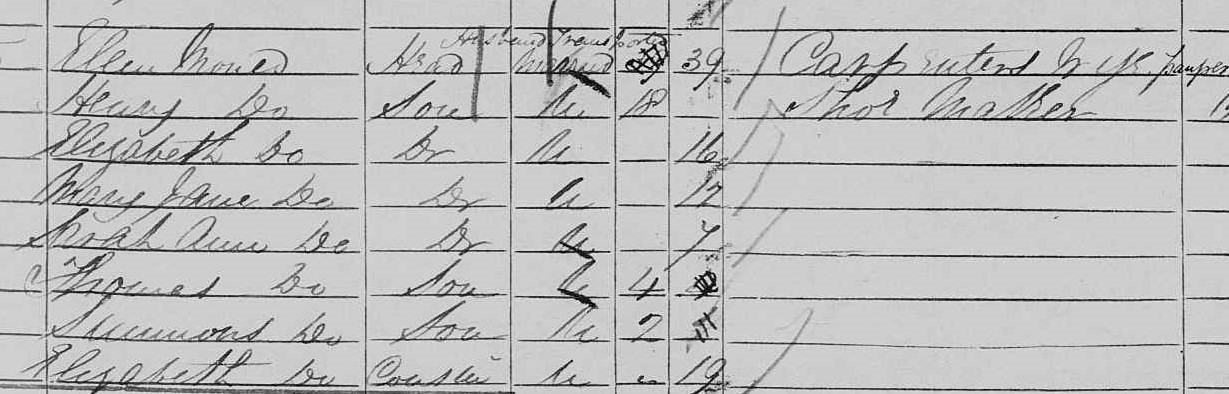
Figure 1: Ellen Mould in the 1851 Census
In 18615 Ellen is recorded as being 48 years old, married and the Head of the Household. There is no record of any occupation. The household comprised five other occupants; four of Ellen and William’s children and John Bennett who was a police constable.

Figure 2: Ellen Mould in the 1861 Census
Overwritten on both the 1851 and 1861 Enumeration Sheets for her household is the statement “Husband Transported”. As both the 1851 and 1861 Enumeration Sheets were not completed by the occupant, the additional information must have been included by the Census Enumerator.
Information about the whereabouts of William Mould in 1841 is found in an article in the Northampton Mercury of 19th October 18396. This gives a report of the trial of a William Mould at the Northamptonshire Michaelmas Quarter Sessions. He was accused of stealing two £5 notes from Henry Hercock in King’s Cliffe. Henry Hercock was also a sawyer. Although he pleaded not guilty, on 17 October 1839 William Mould was found guilty as charged and sentenced to transportation for 7 years. Two other prisoners were sentenced to transportation by the same Court: John Woodford for 10 years and John Law for 7 years.
All three were transferred on 5th November 18397 to the prison hulk “Leviathan” moored in Portsmouth Harbour to await transportation. John Woodford was transported soon after but the 1841 Census (undertaken on 6th June 1841) records that both William Mould and John Law were still on the Leviathan in Portsmouth Harbour8.

Figure 3: William Mould recorded on the Leviathan in the 1841 Census
Both remained on the Leviathan until July 1843 when they were pardoned9. July 1843 is about half-way through their 7-year sentences, but no record of why they were not transported overseas or why they received pardons have so far been identified.


Figure 4: William Mould granted a pardon on 25th July 1843
William Mould must have returned to Woodnewton because baptism records show that he and Ellen had three more children in the mid to late 1840s10. There were none born between 1839 and 1843 – the time of his imprisonment on the Leviathan.
William Mould is not recorded in Woodnewton in the 1851 Census, either. At that time Ellen Mould was living with six children in Woodnewton; Henry aged 18 (who was living with his grandparents – William Mould’s parents – in 1841), Elizabeth (Eliza) aged 16, Mary aged 12, Sarah Ann aged 7, Thomas aged 4 and Simmons aged 2. Charles Mould who is listed in the 1841 Census as Ellen’s (and William’s) son died in 1849.
In March 1850 William Mould appears in the records of Lincolnshire Lent Assizes Court. The Lincolnshire Chronicle newspaper of 15th March11 reports that he was found guilty on 9th March 1850 of trying to cash a cheque in Market Deeping for £30 10s with intent to defraud the Stamford, Spalding & Boston Banking Company. He was convicted and sentenced to 10 years transportation to Western Australia. The court had been advised that he had previous been convicted for stealing two Bank of England notes and sentenced to be transported. In February 1851 he was sent to Dartmoor Prison to await the implementation of the sentence12. This explains his absence from the 1851 Census records of Woodnewton, but it has not been possible to identify precisely where he was on Census night, 30th March 1851. Unlike in 1841, people in institutions such as prison were not identified by name in the 1851 Census but by initials. Examination of the 1851 Census returns of Dartmoor prison has failed to identify him, although he could have been transferred to another prison.
In the 1850s prisons were places where convicts stayed until their sentence was carried out. However, Dartmoor Prison at that time was being transformed by convict labour from a former Napoleonic Prisoner of War facility to a civilian prison, and a carpenter may have been a useful inmate.
He was eventually transported to Western Australia in late 1853 on a ship named Sea Park. The Sea Park left London on 30th December 1853 and arrived at the Swan River Penal Colony (Perth) in Western Australia on 5 May 1854 with 304 convicts on board, one of which was Convict Number 2687 William Mould13. Convict 2687 is recorded as being born in 1813, married with 6 children, and he was a carpenter.

Figure 5: Record of William Mould on the Sea Park and in Western Australia
The records of the Sea Park voyage also show that immediately on arrival in Western Australia on 5th May 1854 he was issued a Ticket of Leave14.
The Ticket of Leave system was a form of parole to reduce the burden on the Colonial Government of providing food to the convicts. They were awarded to those who seemed able to support themselves and/or for good behaviour.
On 19th January 1856 William Mould was granted a Conditional Pardon15. A Conditional Pardon was given when the convict had served half of the sentence and removed all the restrictions except leaving the colony until the whole of the sentence had been served. However, as most convicts could not earn enough money to pay for the voyage back to England the majority remained in Australia for life.
What happened to William Mould after the granting of the Conditional Pardon is unclear. There are records of a William Mould serving on ships in Australia in the period16. These records show that this William Mould was British and the same age as the William Mould from Woodnewton, but there is no definitive link. Nevertheless, if William Mould was in Australia in 1861 he could not be recorded in the 1861 Census of Woodnewton.
Notwithstanding all the difficulties and restrictions, William Mould does (re)appear in the 1871 Census return of Woodnewton17.

Figure 6: William and Eleanor (Ellen) Mould in 1871 Census of Woodnewton.
He is recorded as Head of the Household and his wife is Eleanor (Ellen) Mould. Both have the ages that would be expected if they are the same people recorded earlier. William Mould’s occupation is shown as a carpenter. Also, in the household is their son Thomas and George William Savage who is recorded as the grandson of the head. George William Savage was born in 1862 and was the son of Mary Jane Savage. Mary Jane was born Mary Mould in 1839 but unfortunately she had died in 1865.
In the 1881 Census William and Ellen Mould are still living in Woodnewton but now with a Charles Henry Mould, another grandson who was born in Leeds, the son of their son Thomas18. Thomas was a railway servant who lived in Leeds with his wife and two other young children, together with three boarders all born in Woodnewton – William Ginn, Robert Fitzjohn and Samuel Jolly (all railway servants).
Why William Mould could come back, and how he came back from Australia, have yet to be discovered. He died in the 1886 and is buried in St Mary’s Churchyard19. Ellen is recorded in the 1891 Census as a widow living on her own and dependent on the earnings of her sons20. She died in Woodnewton later the same year and is also buried in St Mary’s Churchyard21.
NOTE
In the records so far identified of the trials, convictions, imprisonments and transportation of William Mould the village of “Woodnewton” is not mentioned. Other than the over-written notes in the 1851 and 1861 Censuses, there is no direct evidence linking the William Mould who was transported on the Sea Park to the William Mould who was married to Ellen (Eleanor) Mould. There is only circumstantial evidence but relying solely on age and year of birth is problematic. In the 1841 Census for example only children under 15 had their exact ages recorded and the ages of everyone else were “rounded” to the nearest 5. In the 1841 Census William Mould is recorded as being 25 years old, and by implication was born in 1816, whereas the 1871 Census records him has 57 years old, or born in 1814. It is known however that William Mould was baptized in 1812. To overcome any problems, in this research, documents giving age and year of birth have been used in conjunction with records of occupation, places of conviction and number of children.
One further “complication” is that there is an uncollaborated record of a marriage between a William Simmons Mould and Maria Marsh in Perth, Western Australia on 12th February 185722. Both are recorded as “widowed.” William Mould’s mother’s maiden name was Simmons, and William and Ellen had a son called Simmons who was born in 1849.
REFERENCES
This article is based on information obtained from the following sources, which are publicly available via the internet or by subscription. There are areas still to be researched, and anyone who may be able to help is invited to contact the Group.
- St Mary’s Church Woodnewton – Register of Baptisms.
- St Mary’s Church Woodnewton – Register of Marriages.
- St Mary’s Church Woodnewton – Register of Baptisms and Find My Past – 1841 Census.
- Find My Past – 1851 Census.
- Find My Past – 1861 Census.
- Northampton Mercury – 19/10/1839.
- Northampton Mercury – 05/11/1839.
- Find My Past – 1841 Census.
- Prison Hulk Leviathan – Prisoner Records
- St Mary’s Church Woodnewton – Register of Baptisms and Find My Past – 1851 Census.
- Lincolnshire Chronicle – 15/03/1850
- Lincoln Gaol Records.
- Fremantle Prison History – Convict Database
- Fremantle Prison History – Convict Database
- Fremantle Prison History – Convict Database
- Find My Past – NSW Crew Lists 1856 and 1857 .
- Find My Past – 1871 Census.
- Find My Past – 1881 Census.
- St Mary’s Church Woodnewton – Register of Burials.
- Find My Past – 1891 Census
- St Mary’s Church Woodnewton – Register of Burials.