
While sitting in the church at a villager’s funeral recently, my eye wandered upwards along the north wall, just in front of the radiator towards the rear – and what did I see?
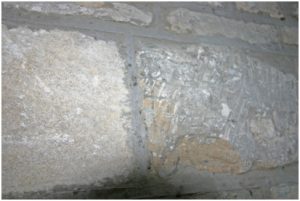
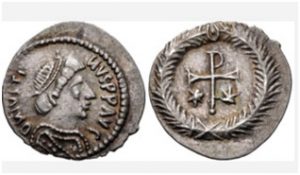
If you look carefully on the top left of the stone the symbol of the Chi-Rho has been engraved. The two Greek letters superimposed on one another form the beginning of Christ’s name. Usually the Chi is nearer in form to an “X” rather than the angular imitation of the cross of the crucifix, but both forms exist, and one like ours can be seen on a coin of the Byzantine Roman Emperor Justin (c. 565-576)
The symbol was originally adopted by the Emperor Constantine I (the Great) after his revelation before the battle of the Milvian Bridge on 28 Oct. C.E. 312. There, having been declared Emperor in York, he met the other contender Maxentius who was waiting at the river Tiber before Rome. On the night before the battle, Constantine had a dream in which he saw the sun overlain by a cross, and beneath, the words ” in hoc signe vinces“, or “In this sign prevail”. The next morning Constantine ordered his men to paint crossesd on their shields, and they marched to war as “Christian soldiers” Constantine’s victory resulted in the official religion of the Empire being declared as Christian.
So what is our symbol doing there? The academic jury is out for the moment. There are rare examples of mediaeval Chi-Rhos, but there is also the possibility that the stone was reused from the Roman Villa at Apethorpe – watch this space!
Geoffrey Dannell FSA
2018