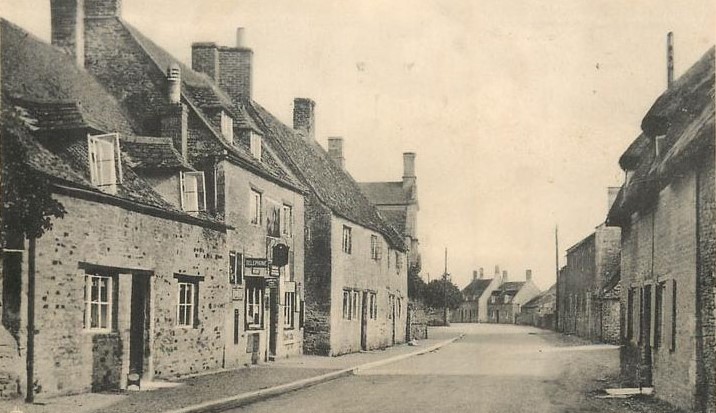
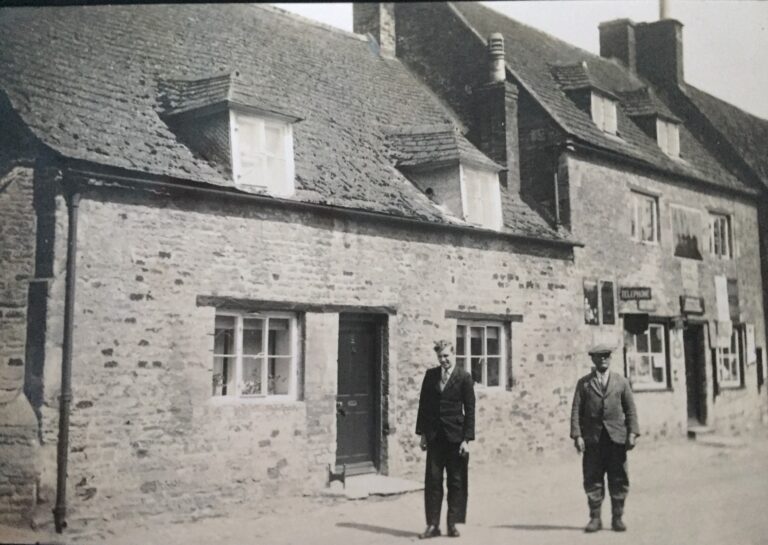
Although, John William Collin was born at Easton near Stamford in 1867, he came to Woodnewton with his mother sometime before 1881, because he is shown in the census of that year as being the stepson of the head of the household, James Jacob. John married Emily Frances Mould of Woodnewton in 1898. The 1901 census shows the Collin family living at a cottage on the north side of Town Street, next to the end house that we know as Peacehaven (Shop at 52 Main Street). John is listed as a Market gardener, so would be using the barns and land to the rear of the house for his business.
At that time there was no Post Office in Woodnewton and the closest money order office was at Nassington and telegraph office at Kings Cliffe. The Parish Council records shows that they tried to provide a facility in the village as early as 1902 as shown in this snippet from the minutes:
The 1911 census and Kelly’s Directory of the same year only shows John as a market gardener. However, by the time that the 1914 Kelly’s Directory was printed, he was listed as a shopkeeper as well. The 1921 census shows the Collin family as only being in a farming business, and the 1928 Kelly’s only shows John Collin as a shopkeeper, therefore we still do not know whether Woodnewton had postal facilities within the village by that time.
However, by the time the 1939 Register was taken, the Collin family were still living at the same property and Emily was now a post mistress and John was listed as a retired farmer (he was eight years older than his wife). So, during the intervening years, the Parish Council must have been successful in obtaining postal facilities in the form of a post office.
Emily died in 1943, but her youngest son, Edward who was born in 1918, was still living at home and working as the manager of the shop, must have carried on runnning the shop until his father died in 1949, when the property and business was sold.
 This business invoice pad shows that the next proprietor was a T W G Giibert. We know that Major Thomas Walter George Gilbert and his wife, Evelyn moved into the property in April 1950, as there is a reference to Thomas Gilbert in a newspaper article that was printed in the Peterborough Standard on the 5th May:
“When Major T Gilbert, of Woodnewton, who recently purchased the business of Mr J Collin, was searching in a cupboard underneath the staircase, he came across a live Mills bomb, a relic of the 1914-18 war. The village constable, P.C. , Whalley was notified and he took the bomb to the police station. It was afterwards sent to Weedon for disposal”.
 Thomas Gilbert, known as Humphrey to the village people, was running the store during the time of the Queen Elizabeth II’s Coronation, and even though rationing was still in operation, he was able to obtain the majority of the food required for the village tea party that took place during the afternoon. Food rationing did not finish until a year later on 4th July 1954. The Group have been given a ration book belonging to a village resident.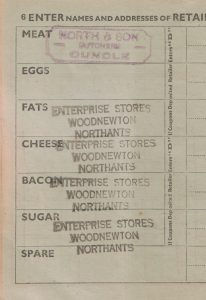
Thomas continued to run Enterprise Stores until 1964, when he sold the business to Sqn Ldr J A Ormerod. However, it was only the shop that was sold as the Post Office business had been relocated to Mac Allen in 1962.
Mr Ormerod was only in the village for a very short while and when he left in 1966, he closed the shop and sold the building as a residential property.