
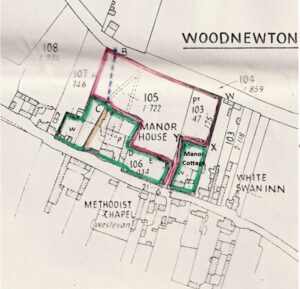
 The core of this cottage, which was originally known as Manor Cottage, because it was built within the grounds of the Manor House, dates back to the 17th century; and was built around a large ingle-nook fireplace. Originally, it consisted of just two rooms with an attic, which could only be accessed by a ladder over the fireplace. Some key architectural features, like the five-light canted ovolo-moulded1 “bow window” and the fireplace, were incorporated from an even earlier structure.
The house was constructed using coursed limestone and a Collyweston slate roof. The original entrance was on the east side, in the side wall. Later, probably in the 18th century, a two-storey extension was added to the east. This included a passage leading to the rear and a large walk-in larder running from the front to the back. This addition transformed the house into a typical Northamptonshire “through passage” property, with the main entrance now facing the street.
Introduction
Knight’s Cottage is a charming historical property with a rich past. Though early census records lacked detailed addresses, a combination of historical research, family photographs, and physical evidence from the building itself has helped uncover its past inhabitants and their stories.
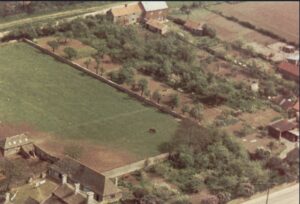
The land attached to the cottage originally extended from Main Street to Back Lane (Orchard Lane) and was used for market gardening. The site was part of the Apethorpe Estate, but in 1921 the adjacent Manor Farm was sold by Mr Brassey of Apethorpe Hall to John Leonard. The sale included Manor Cottage and its market garden land. Ownership (but not occupants) of the cottage and land changed several times until in 1974 that part of the site adjacent to Back Lane, together with the adjoining field known as The Paddock, were sold to R A Reeve (Construction) Company Limited.
Below are details of the history of the inhabitants, from its earliest recorded residents that can be found, to modern renovations.
 The Mould Family
John Mould was the sixth child of John and Ann Mould, who were recorded as living on Town Street in the 1841 census. John was born in Woodnewton, but by the time of the 1851 census he had moved away to work as a groom. By 1861 he was married to Sarah Gee, and the couple had settled in Ulceby, Lincolnshire, where John was employed as both a groom and a gardener.
Within a few years, John and his family returned to Woodnewton, where they took up residence at Knight’s Cottage. There, John worked as a gardener, using the large garden attached to the property, stretching as far back as the Lane known as Back Way; they produced fruit and vegetables. After John’s death in 1876, Sarah and Thomas continued the business, although Thomas later established his own enterprise at Cherry Holt following his marriage in 1886.
The Staniland Family (1886–1923
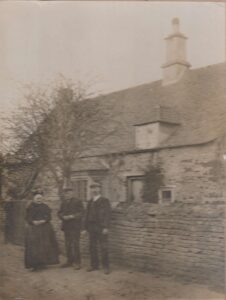 John’s widow, Sarah, remarried in 1886 to George Staniland, who continued the work as a market gardener and coal dealer. This was confirmed by an interesting discovery made during later renovations, when a substantial amount of coal dust was found in one of the buildings. This physical evidence, combined with census records, confirms that the Staniland family lived at these premises for more than three decades.
Further support comes from a photograph dating from the 1890s, provided by a descendant of the Mould family. The image shows George, Sarah, and her son, John Samuel Mould, standing in front of the cottage. George died in 1916, but Sarah continued to live there until her death in 1923.
The Knight Family and the Cottage’s Name (1923–1978)
The Knight family had lived in Woodnewton since 1911, but they likely moved into the property after Sarah Staniland’s death. From then on, it became known as “Knight’s Cottage.” Charles Knight, a retired building labourer, was an avid gardener. Newspaper reports frequently mention him winning awards for his potatoes, carrots, and cabbages. The cottage had a spacious garden to the rear and west side of the property where Charles cultivated his prize-winning vegetables.
Charles’ later years were marked by tragedy. By 1954, he was 77 years old, suffering with poor eyesight due to cataracts, and acute deafness. On the misty morning of August 3, 1954, he was found drowned in the garden well (as with many of the old properties in Woodnewton, the water source came from a garden well 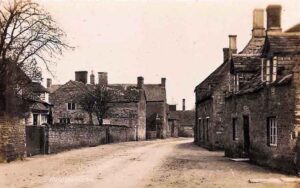 before mains water was installed). Walter, Charles’ son speculated that he may have become disoriented and believed his eyesight had worsened overnight, leading to his untimely passing.
Walter remained at the cottage with his mother until his death in 1978.
Later Years and Renovations
Following Walter Knight’s passing, the property was put on the market and purchased in 1979 by Geoff Dannell. In 1986, plans for a two-storey side and rear extension, including a garage were granted. This was the first of several improvements made, ensuring the cottage retained its historic charm while being modernized for contemporary living. A room over the garage was added in 1993 and the last alteration made in 2005, was a large single storey extension for a library and office at the rear of the property.
Footnotes
1. https://britishlistedbuildings.co.uk/101065856-knights-cottage-woodnewton
2025